
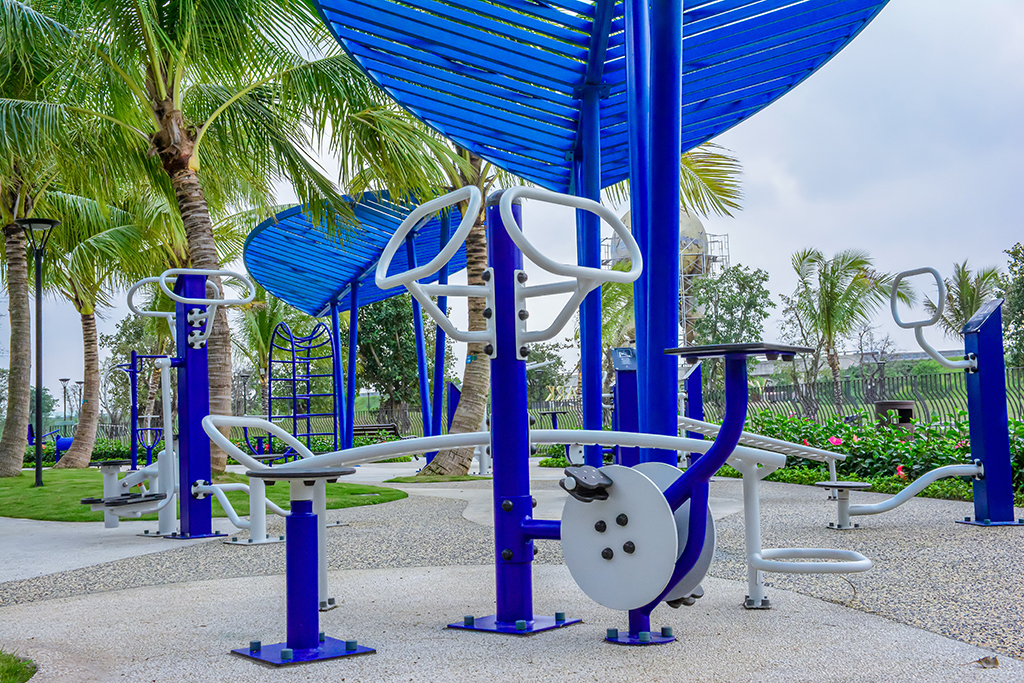
 Share
ShareOutdoor Fitness Equipment for Parks: Planning Guide
Why Most Outdoor Gyms Are Underused
Outdoor fitness equipment for parks succeeds or fails on planning, not on the machines. Plenty of installations sit empty within a year because the mix was wrong, the location was wrong, or nobody thought about shade and surfacing. This guide sets out how to plan a fitness zone that people return to.
The failure pattern is consistent. A row of identical machines is placed in the sunniest corner of a park, on bare ground or grass, with no signage, no progression between easy and hard, and no seating. Early users try it, find it either too easy to be interesting or too exposed to be comfortable, and stop coming. Everything below is aimed at avoiding that outcome.
Know Your Standard: EN 16630
Adult outdoor fitness apparatus is not playground equipment and is not covered by the playground standards. The relevant reference is EN 16630, the European standard for permanently installed outdoor fitness equipment. It addresses the differences that matter with adult users: heavier loads, deliberate exertion, unsupervised use, and the absence of an age-restricted user group.
Practical consequences for a specifier:
- Ask for third party test evidence against EN 16630 for each item, referencing the exact product.
- Do not accept EN 1176 certification as evidence for fitness apparatus. They are different standards with different requirements.
- Where a park combines a children’s play area and a fitness zone, both standards must appear in the specification. The playground side is covered in our guide to playground equipment safety standards.
- Confirm the manufacturer’s stated user weight limits, required clearances around each station, and required surfacing conditions, then check they fit the site.
- Require clear instructional signage on or beside each station, since there is no instructor present.
A frequent and serious error is placing fitness machines inside a children’s play area on the assumption that one set of clearances covers both. It does not, and mixed use creates real risk when small children play under moving adult apparatus.
Decide Who the Zone Is For
A park fitness zone typically serves several distinct groups, and each has different needs. Naming them before you select equipment prevents the generic row of machines.
Older adults
Often the most consistent daily users, especially in the early morning. They want low impact, seated or supported movement, joint mobility and gentle cardio: pedal and cycling stations, seated pull and push apparatus, shoulder and hip rotation wheels, walking and balance features, plus handrails and seating nearby.
General adult fitness users
Body weight training apparatus: pull up and dip bars, parallel bars, incline benches, rings, wall bars, plyometric steps. This group values solid, stable steel apparatus at correct heights more than machine variety.
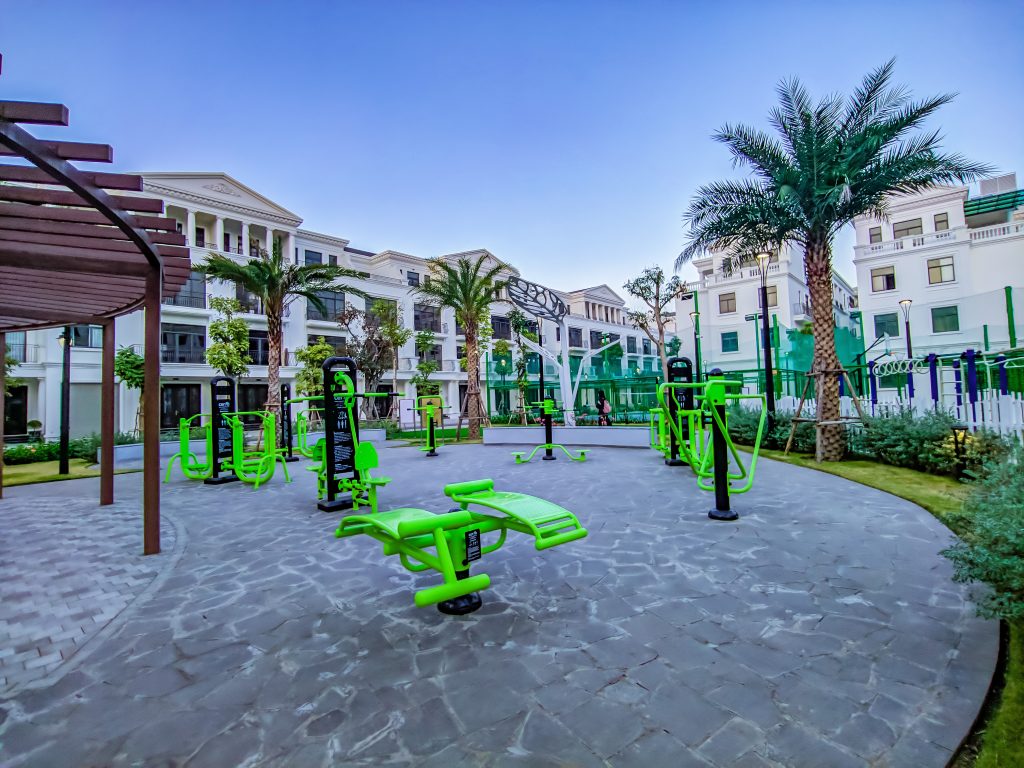
Calisthenics and street workout users
A committed minority who will use a well built rig intensively and become the visible activity that draws others in. They need a multi-bar rig with varied bar heights and diameters, adequate headroom, and generous impact absorbing surfacing under the bars.
Teenagers
Often ignored, yet a fitness zone is exactly what this group wants once they have outgrown playground equipment. Agility, climbing and parkour-style elements alongside the fitness rig serve them well.
Parents and carers
Adults exercise where they can keep an eye on their children. Placing the fitness zone within sight of, but clearly separated from, the play area substantially increases use.
Station Mix: A Balanced Layout
| Function | Typical stations | Notes for the specifier |
|---|---|---|
| Warm up and mobility | Rotation wheels, hip twist, shoulder wheels, stretch posts | Place at the entrance to the zone so the sequence reads naturally |
| Cardio | Pedal stations, cross trainer style units, air walkers, steppers | Moving parts mean higher maintenance; check bearing and bush quality |
| Upper body strength | Pull up bars at several heights, dip bars, parallel bars, rings, chest press | Highest wear items; specify bar diameter and grip finish |
| Lower body and core | Leg press, squat frames, incline sit up benches, step platforms | Benches need drainage detailing so water does not pool |
| Balance and agility | Balance beams, stepping posts, agility ladders, low walls | Low cost, high use, works for a wide age range |
| Accessible stations | Wheelchair accessible arm and hand apparatus | Requires a firm level approach and clear transfer space |
| Support | Seating, shade, drinking water, waste bin, signage | Frequently cut from the budget and frequently the reason a zone fails |
A good rule is to cover every function in the table before adding a second unit of any one function. Breadth attracts more users than depth.
Siting and Layout
Location within the park
Put the zone on an existing desire line or beside a walking loop, visible from a path or road. Visibility does three things: it advertises the facility, it provides natural surveillance that deters vandalism, and it makes users feel safe exercising alone early or late.
Shade and orientation
In Vietnam’s climate this is decisive. Peak usage is early morning and evening, so an unshaded zone is unusable for much of the day. Use existing tree canopy where possible, add shade structures where not, and orient stations so users are not facing directly into low sun.
Clearances and circulation
Respect each manufacturer’s stated clearance around every station and keep circulation routes outside those clearances. Users queue, stretch and rest between sets, so allow room for people standing around a station, not just using it.
Grouping
Cluster by function in a loop rather than a straight line. A loop encourages users to move through a sequence and makes the zone feel like a facility rather than a display.
Surfacing Under Fitness Equipment
Surfacing choice under fitness apparatus is driven by different considerations than under playground equipment, but it is just as important.
- Under bars and rigs where users hang, drop and jump, impact absorbing rubber surfacing is appropriate, and the manufacturer’s requirements should be followed.
- Under seated and static machines, a firm, well drained, non slip surface matters more than impact attenuation.
- Grass fails quickly. Concentrated foot traffic at each station turns grass to mud within a season, which then makes stations unusable in the wet.
- Drainage first. Fitness zones are used at dawn when dew and overnight rain are still present. Positive falls and a permeable build-up are essential.
- Accessible approach. At least one route into the zone and to any accessible station should be firm, level and continuous.
The comparison in our article on EPDM versus rubber tile safety surfacing applies to fitness zones too, with the caveat that tile joints take heavier point loading beneath rigs.
Maintenance: The Part That Determines Life
Outdoor fitness equipment has moving parts, exposed hardware and heavy adult loading, so it degrades faster than playground equipment if neglected. Plan for it at procurement stage.
- Routine visual checks for loose fixings, damaged grips, missing caps and vandalism.
- Periodic operational checks of bearings, bushes, pivots, cables and any adjustment mechanism.
- Annual detailed inspection including foundations, corrosion at ground level and structural fixings.
- Spare parts availability. Confirm that grips, bearings, bushes and fasteners can be supplied for years, not months.
- A named responsible person and a written record. Without a log, nothing gets inspected.
Our maintenance checklist article gives a format you can adapt for fitness stations, and our project planning guide shows where maintenance commitments should be locked into the contract.
Procurement Checklist
- Defined user groups and expected peak usage times.
- Site survey with levels, drainage, existing trees, services and sightlines.
- Station schedule covering every function in the mix table above.
- EN 16630 test evidence required at submittal for each item.
- Manufacturer clearance dimensions transferred onto a dimensioned layout drawing.
- Surfacing type and extent by station type, with drainage design.
- Shade strategy and orientation study.
- Support elements: seating, water, bins, lighting if evening use is expected.
- Instructional signage on every station, plus a zone information board.
- At least one accessible station with a firm level approach.
- Foundation design and confirmation of installation depth relative to finished surfacing.
- Warranty, spare parts and scheduled maintenance commitment in writing.
- Handover pack: manuals, as-built drawings, inspection records.
Frequently Asked Questions
What standard applies to outdoor fitness equipment?
EN 16630 covers permanently installed outdoor fitness equipment. It is separate from EN 1176, which covers children’s playground equipment. If your park includes both a play area and a fitness zone, specify both standards and request the correct test evidence for each category rather than accepting one certificate for everything.
How much space does a park fitness zone need?
Work from the station list rather than a fixed area figure. Each item has a manufacturer specified clearance that must be kept free, and circulation between stations sits outside those clearances. Add space for shade, seating and an accessible approach, then confirm the total against the available site before finalising the station count.
Can outdoor fitness equipment go next to a children’s playground?
Adjacent, yes, and it is often desirable because parents can supervise while exercising. Inside the same area, no. The clearances, user weights and standards are different, and small children playing beneath moving adult apparatus is a genuine hazard. Separate the zones clearly while keeping sightlines between them.
Which stations get used the most?
In practice, simple body weight apparatus such as pull up and dip bars, plus low impact mobility and pedal stations for older adults, tend to see the steadiest use. Balance and agility elements also perform well because they suit a wide age range. Complex single purpose machines are usually the least used per unit of cost.
Plan Your Fitness Zone With 067 Group
067 Group provides consultancy, design, supply and installation of outdoor fitness equipment, playground equipment and safety surfacing, starting with a site assessment and measurement before any layout is drawn. To discuss a park or residential fitness zone, contact our Hanoi office at No 38 Ven Ho Ha Dinh street, Ha Dinh ward, Thanh Xuan district, Hanoi, on +84 24 66 73 3777 or +84 24 66 73 9777, or write to us through the contact page. Our process page sets out each stage from brief to scheduled maintenance.