

 Share
SharePlayground Safety Surfacing: EPDM vs Rubber Tiles
The Decision That Costs More Than the Equipment
Playground safety surfacing is often treated as the finish that gets value engineered last. That is backwards. It is the element that absorbs falls, that takes the heaviest wear, and that fails first when specified badly. This article compares poured EPDM systems with prefabricated rubber tiles so you can choose on evidence rather than on unit rate.
Both products do the same job: reduce the severity of head injury when a child falls from equipment. Both can be supplied with a critical fall height determined by test to EN 1177 or ASTM F1292. The differences are in installation, drainage, repairability, tolerance of a poor substrate, and how they age under sun and monsoon rain. Those differences decide total cost over ten years.
How Both Systems Are Built Up
Poured in place EPDM
A poured in place system is laid wet on site in two layers. The lower layer is a shock pad of recycled rubber granules, typically SBR, bound with polyurethane. The upper wear layer is EPDM granules, a synthetic rubber with good UV and colour stability, also polyurethane bound, usually a thin layer of around 10 to 15 mm. Total thickness is set by the required critical fall height and typically ranges from around 20 mm for very low equipment up to 60 mm or more where fall heights are significant. The result is a seamless, permeable surface that can be laid in curves, colour blocks, graphics and pathways.
Prefabricated rubber tiles
Rubber tiles are factory moulded in fixed sizes and thicknesses, commonly around 500 by 500 mm, with an interlocking or dowel jointed edge. They are supplied in a range of thicknesses, each with its own tested critical fall height, and are laid on a prepared base, either bonded or laid loose with adhesive at the joints depending on the system. Because they are made under factory conditions, density and thickness are consistent in a way that on-site mixing cannot always match.
Direct Comparison
| Criterion | Poured EPDM | Rubber tiles |
|---|---|---|
| Appearance | Seamless, any shape, colour blending, graphics and inlays possible | Visible grid of joints, colour by tile, limited shaping |
| Critical fall height | Set by total thickness, can be varied across the area under different equipment | Set by tile thickness, varied by changing tile type between zones |
| Substrate demands | Needs a sound, well drained, correctly graded base; defects telegraph through | More forgiving of a slightly imperfect base, though a poor base still causes rocking and joint lipping |
| Installation | Weather dependent, needs skilled crew, curing time before use | Faster, less weather sensitive, easier to phase in small areas |
| Joints and edges | No joints; perimeter edge detail is the vulnerable point | Joints are the vulnerable point; can lift or open with movement and heat |
| Repair | Patch repairs possible but colour and texture match is difficult | Single tiles can be lifted and replaced cleanly; easiest repair of any system |
| Drainage | Permeable through the full build-up when correctly laid | Permeable at joints and through some tile types; base drainage is critical |
| Wheelchair and pram access | Excellent; smooth and continuous | Good when new; degrades if joints lip |
| Vandal resistance | Cuts and gouges show and need patching | Individual tiles can be prised up, but also cheaply replaced |
| Best fit | Signature areas, complex shapes, high visual expectation, continuous large areas | Phased works, small or awkward areas, projects prioritising easy maintenance |
Getting the Critical Fall Height Right
The one non-negotiable technical requirement is that the critical fall height of the installed surface equals or exceeds the falling height of the equipment above it. Falling height is measured from the highest intended body support position, not from the top of the structure. To use this properly:
- Ask for a test report to EN 1177 or ASTM F1292 for the exact system build-up you are buying, including shock pad thickness, wear layer thickness, granule type and binder ratio.
- Reject generic marketing tables that quote a fall height without a report reference.
- Build a schedule listing every item of equipment, its falling height, and the surfacing specified beneath it. This is the single most useful document in the submittal pack.
- Remember that a surface tested at one thickness does not perform at a lower thickness. Require thickness records taken on a grid during installation.
- Agree in advance how thickness will be verified, usually by core sampling at a small number of agreed points with the cores repaired afterwards.
The wider framework of standards, and the submittal evidence to demand from any supplier, is covered in our guide to playground equipment safety standards.
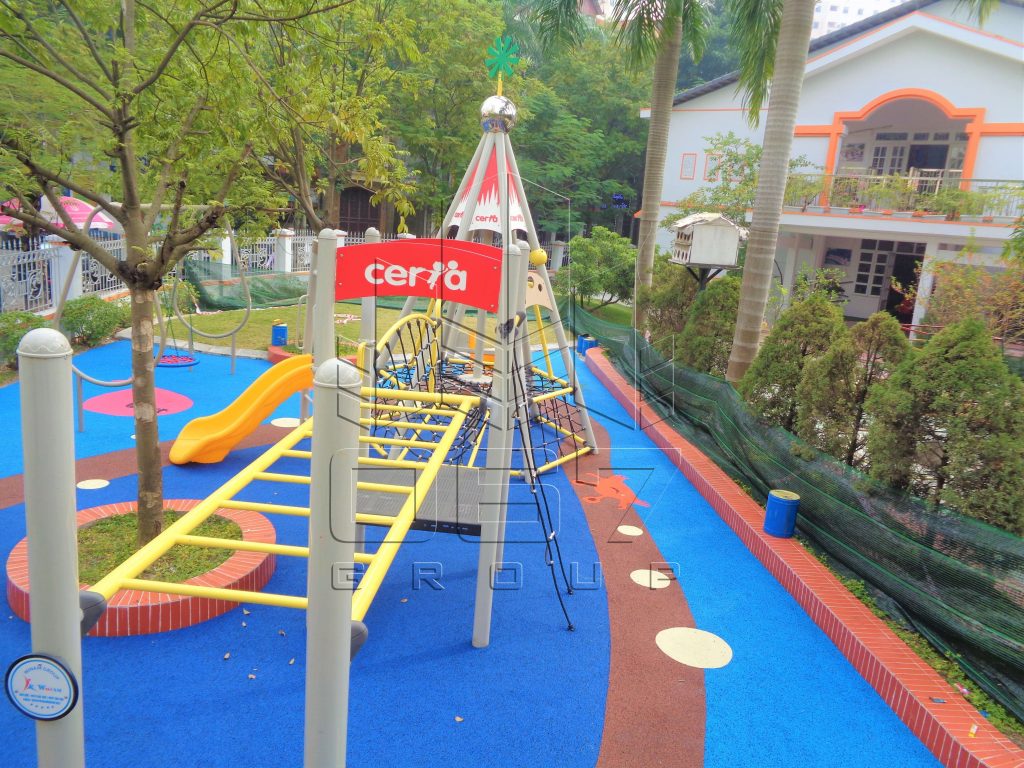
The Base Is Where Projects Actually Fail
Most surfacing complaints trace back to what is underneath, not to the rubber. A shock pad cannot compensate for a base that holds water or moves.
Drainage
In Vietnam’s rainfall, standing water under or on the surface is the fastest route to failure. It softens the base, promotes algae growth on the wear layer, and in tiled systems it lifts joints. Specify a permeable sub-base with a positive fall to a drainage outlet, and confirm the outlet actually connects to something.
Levels and falls
Get levels right before laying. Chasing a level correction in the shock pad thickness changes the tested build-up and therefore the critical fall height.
Edge restraint
Every rubber surface needs a restrained edge, whether a concrete kerb, a haunched edge or a metal trim. Unrestrained edges curl, get picked at by children, and then unzip.
Equipment foundations
Foundations must be set at the correct depth relative to finished surfacing level and installed before surfacing. Cutting into finished surfacing to add a post later is a permanent weak point.
Life Cycle Cost, Not Unit Rate
Compare on installed cost plus ten years of upkeep, not on square metre rate. The factors that move total cost are:
- Area actually required. Impact areas are driven by equipment layout. A layout that reduces overlapping impact areas can cut the surfaced area meaningfully with no loss of play value.
- Thickness by zone. Do not surface the entire area to the thickest requirement. Specify by falling height zone, with thicker build-up only where it is needed.
- Repair regime. Tiles win on repair simplicity. Poured EPDM wins on the absence of joints to repair in the first place. Which matters more depends on whether you have a maintenance team and a stock of spare tiles.
- Cleaning. Both systems need periodic cleaning to prevent organic build-up and to keep drainage paths open. Budget for it.
- Inspection. Surfacing condition belongs in the routine inspection regime alongside the equipment. Our playground equipment maintenance checklist includes surfacing items.
Choosing Between Them: A Short Decision Guide
- Large continuous area with high visual expectations, for example a residential development or hotel: poured EPDM, with colour blocking used to define age zones.
- Phased school project built over several years: rubber tiles, for the easier phasing and simple in-house repair. Selection logic for school sites is covered in our article on choosing outdoor playground equipment for schools.
- Small or irregular courtyard with awkward access: tiles, because there is no wet mixing and no curing window to manage.
- High falling heights from tall towers or climbing nets: either, provided the tested critical fall height covers the falling height. Verify the report before committing.
- Rooftop or podium installation: careful drainage and waterproofing coordination is decisive, and either system can work only if the deck build-up is resolved first.
- Accessibility as a priority: poured EPDM, for the continuous joint free surface.
Frequently Asked Questions
How thick should playground safety surfacing be?
Thickness follows the falling height of the equipment above, not a general rule. Typical build-ups range from around 20 mm for very low equipment to 60 mm or more where fall heights are significant. The only valid basis is a critical fall height test report to EN 1177 or ASTM F1292 for the exact build-up you are installing.
Does EPDM get too hot in direct sun?
Any dark rubber surface heats up in strong sun, and darker colours heat more than lighter ones. Two practical measures help: choose lighter tones for large open areas, and plan shade, whether from trees, canopies or the equipment itself, over the areas where children sit or lie on the surface.
Can rubber tiles and poured EPDM be used in the same playground?
Yes, and it is common. Poured EPDM is often used for the main play zones and pathways, with tiles in service areas, phased extensions or locations where easy replacement matters. Detail the transition between them carefully, with a restrained edge, so the junction does not become a trip point.
How long does playground safety surfacing last?
Service life depends on use intensity, sunlight, drainage and maintenance far more than on the product name. A well laid system on a sound, well drained base with routine cleaning and prompt repair will substantially outlast the same product on a poor base with standing water. Specify the base as carefully as the rubber.
Get a Surfacing Recommendation From 067 Group
067 Group supplies and installs rubber and EPDM safety surfacing alongside playground and outdoor fitness equipment, which means the falling heights, impact areas and surfacing build-up are resolved together rather than in separate packages. To discuss a specific site, contact our Hanoi office at No 38 Ven Ho Ha Dinh street, Ha Dinh ward, Thanh Xuan district, Hanoi, on +84 24 66 73 3777 or +84 24 66 73 9777, or use the contact page. Examples of completed installations are on our projects page.