
 Share
ShareWater Play and Splash Pad Design Guide
Why Water Play Belongs in More Playgrounds
Water is the fastest way to turn an underused playground into the busiest corner of a project. A well planned splash pad design gives young children open ended, low risk play in a hot climate, and gives owners a feature that is easier to supervise than a pool. This guide covers every decision, from water source to slip resistant surfacing.
In Vietnam’s climate, a conventional metal and rubber playground can sit empty through the hottest part of the day, when surfaces are too hot to touch and children would rather stay indoors. Water changes that arithmetic. It cools the surrounding air, draws families for longer stays and suits a wider age range than almost any single piece of fixed equipment, because the play is open ended rather than scripted. For a developer, a resort operator or a municipal parks department, that means higher footfall, longer dwell time and a feature families remember.
What Splash Pad Design Actually Involves
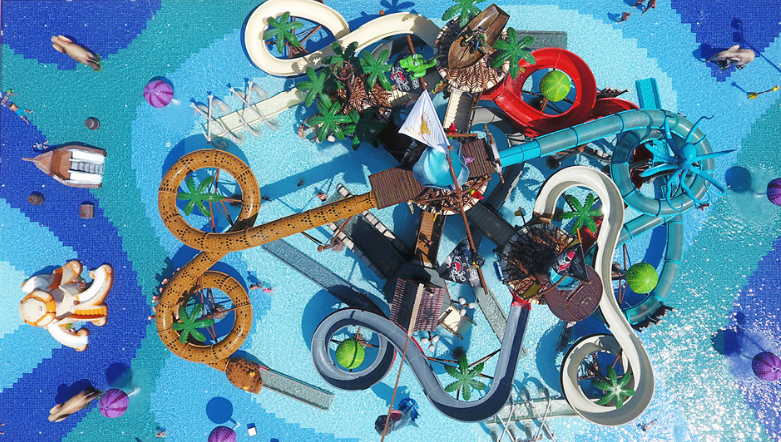
A splash pad, also called a spray park or aquatic play area, is a water play surface with no standing water. Water rises from ground sprays, arches and overhead features, then drains away immediately, which removes the drowning hazard of a wading pool while keeping all the fun. Because there is no deep water, supervision is lighter and the space can often stay open without a lifeguard, depending on local rules.
Good splash pad design brings together several disciplines that do not normally sit in one contract:
- Water features: ground sprays, tipping buckets, mist rings, water cannons and interactive jets, sized and sequenced for the age group.
- Hydraulic system: pumps, manifolds, valves, a controller and a water source, sized for the peak number of features running at once.
- Water treatment: for recirculating systems, filtration and disinfection that keep recycled water safe to touch and splash.
- Civil works: a collection tank, drainage, gradients and a slip resistant, impact attenuating deck.
- Controls: timers, push button activators or motion sensors that keep water flowing only when the pad is actually being used.
Each of these is a design decision, not a catalogue pick. The same set of nozzles on two different sites can need a completely different pump and tank, which is why the process starts with the site rather than the equipment. Locking these decisions early is cheaper, as we explain in our guide to planning a playground project from brief to handover.
Water Source, Recirculation and Treatment
The first question in any splash pad design is where the water comes from and where it goes. There are two families of system, and they lead to very different operating costs and obligations.
Recirculating systems
Water drains into a buried tank, is filtered and disinfected, and is pumped back to the features. This is the responsible choice where water is metered or where a resort cannot afford to waste it, and it is the only realistic option for large schemes. The cost is a treatment plant: a pump, a filter, dosing for disinfection and a controller, plus a daily water quality routine. Design the treatment for the water volume, not the pad area, and keep the tank accessible for cleaning.
Flow through systems
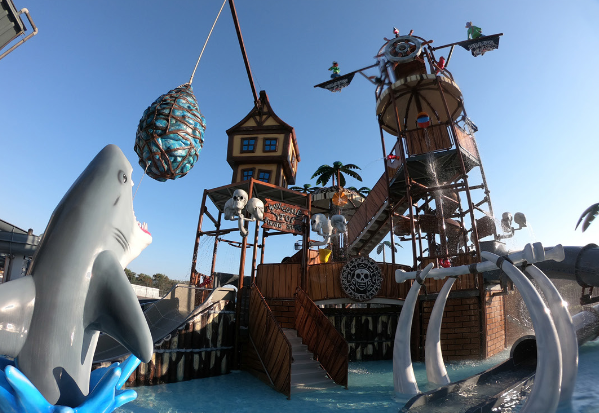
Water passes through the features once and is discharged to drain, stormwater or irrigation. A flow through system is simpler and cheaper to build, with no filtration or chemical dosing, but it consumes fresh water for every hour of operation. It only makes sense where water is abundant and discharge is allowed, which in practice limits it to small seasonal pads and to sites with an existing irrigation or greywater reuse plan.
Whichever system you choose, write water quality into the brief from the start. A pad that recirculates needs a documented testing and dosing routine, and the people who will operate it need that routine handed over, not described.
Slip Resistance, Surfacing and Drainage
Water play is barefoot play, so the deck is the single most safety critical part of the whole pad. A surface that is grippy when dry can become dangerously slippery the moment it is wet, and the difference is not visible on a sample board.
Specify a surface with a proven wet slip rating rather than a product name. For a children’s water play area the practical answer is usually wet pour rubber with a coarse, open finish, laid to falls so water runs to the collection points instead of ponding. The same surfacing can double as impact attenuation under any low level play features, and should be tested where a feature involves climbing or fall heights. Our guide to playground safety surfacing explains how wet pour and rubber tiles compare and where each is appropriate.
Drainage decides whether the pad stays clean. Grade the deck to a central trench or perimeter channel, avoid low spots where water and dirt collect, and make every drain cover flush and finger safe. In a tropical downpour the drainage system is doing as much work as the pump, so size it for the worst storm, not the average day. Once the pad is open, water quality and pump care join the routine, which our guide to playground equipment maintenance covers in the same scheduled rhythm.
Zones, Sequencing and Inclusive Access
A splash pad that sprays everything at full pressure is exciting for ten minutes and empty after twenty. The pads that hold a crowd are sequenced into zones, so different ages and energies can play side by side without a toddler standing in the path of a water cannon.
Zone the pad by energy, not by age label
Keep a gentle mist and low sprays at one end for the youngest children, a wetter, faster zone of arches and tipping buckets in the middle, and a dry deck with seating at the edge where parents can watch without getting soaked. Position the dry zone upwind and within sight of every feature, and give it shade, because the supervising adult stays longer when they are comfortable.
Build accessibility into the surface, not the signage
The best inclusive decision in splash pad design is a zero level, flush deck with no steps or thresholds, which lets a child using a wheelchair move through the sprays on the same surface as everyone else. Add ground level features that spray upward, controls at a reachable height and a transfer friendly bench. These choices cost almost nothing at design stage and are very expensive to retrofit later. The principles are the same ones set out in our guide to inclusive playground design.
A Splash Pad Design Checklist You Can Use
Take this table into the design meeting. Every line is a decision that will either be made deliberately now or made for you later, usually at higher cost.
| Decision | What to specify | What goes wrong if skipped |
|---|---|---|
| System type | Recirculating or flow through, with the reason written down | Operating cost surprise when the water bill arrives |
| Water source | Supply capacity, pressure and any backflow protection | Pad starves at peak demand, features run weak |
| Treatment | Filtration and disinfection sized to water volume | Water quality failure and a closed pad |
| Deck surfacing | Wet slip rating and falls to drainage points | Slips on the first wet weekend |
| Drainage | Gradient, channel size and storm capacity | Ponding, dirt, algae and a pad that smells |
| Feature zoning | Gentle, active and dry zones with sightlines | Mixed ages collide, parents cannot watch |
| Controls | Activators, timers and an automatic shutoff | Water running on an empty pad all day |
| Accessibility | Flush deck, reachable controls, transfer bench | Retrofit cost and a feature that excludes |
| Maintenance access | Vault, tank and valve access without draining the pad | Every service call becomes a shutdown |
| Handover | Water quality routine, spares and operator training | Operators improvise, equipment ages early |
Frequently Asked Questions
Is a splash pad safer than a pool?
Generally yes, because there is no standing water deep enough to drown in. The water drains continuously, so a splash pad removes the main hazard of a wading pool while keeping the play value. It is still a wet, barefoot surface, so slip resistance, surfacing quality and supervision remain the safety priorities, and the same care should be applied as to any children’s facility.
Does a splash pad need a lifeguard?
That depends on local rules and the scheme. Because there is no standing water, many authorities allow splash pads to operate without a lifeguard, but you should confirm the requirement early, because it changes staffing and fencing. Recirculating systems also need someone trained to run the water treatment routine, which is a separate duty from supervision.
How much water does a splash pad use?
Recirculating systems use a modest make up amount, topping up what evaporates, splashes out and is lost to backwash. Flow through systems use fresh water continuously for every hour of operation, so consumption is far higher and depends on feature count, pressure and run time. If water is metered or scarce, a recirculating system is the only sensible choice.
Can a splash pad be added to an existing playground?
Usually yes, because the pad needs only a level area, a water supply and drainage, and it can be installed as a standalone zone beside existing equipment. The practical constraints are the water and power connections, the drainage route and the surfacing transition to the surrounding play area, all of which a site assessment should settle before design starts.
Working With 067 Group
067 Group provides consultancy, design, supply and installation of children’s playground equipment, outdoor fitness equipment, safety surfacing and park and landscape equipment, with management systems certified to ISO 9001:2015, ISO 14001:2015 and ISO 45001:2018. Our process begins by discussing the requirement and budget, then assessing and measuring the location before any concept is drawn, so the water source, drainage and surfacing are specified from real site conditions. After installation we return for scheduled maintenance every three months during the warranty period, with project records kept for future work.
If you are planning a splash pad design for a residential, school, resort or municipal project, contact us through the contact page or the Hanoi office, No 38 Ven Ho Ha Dinh street, Ha Dinh ward, Thanh Xuan district, Hanoi, Vietnam, telephone +84 24 66 73 3777 or +84 24 66 73 9777. You can also see how we structure a project from first meeting to handover on our process page.