
 Share
ShareCost of a 100m2 Children’s Play Area: Budget Breakdown
Why a single figure for a 100m2 children’s play area is meaningless
Buyers usually open the conversation by asking what a 100m2 children’s play area costs. No honest supplier answers with one number. The same floor area can carry a modest toddler set on tiles or a multi-level structure over engineered surfacing, and the two budgets are not comparable. This guide shows how to build the budget yourself, line by line, so quotations can be judged rather than guessed at.
Area is an input, not a specification. What drives cost is play value per square metre, critical fall height, the surfacing system chosen to match it, ground conditions and the standard of documentation required at handover. Fix those, and the number stops moving.
The line items buyers forget
Most overruns come from scope that was never priced, not from equipment that turned out expensive. Work through this checklist before any supplier is approached.
Pre-installation works
- Site survey, levels and setting out.
- Site clearance, excavation and spoil removal.
- Sub-base preparation and compaction.
- Foundations for anchored equipment, sized to the manufacturer’s data.
- Drainage, which is a genuine cost driver outdoors and is routinely omitted.
- Edge restraints, kerbs, fencing and gates where the area needs to be enclosed.
Delivery, installation and commissioning
- Freight, import handling and site access, including any lifting equipment.
- Installation labour and supervision by trained fitters.
- Post-installation inspection by a competent person.
- Handover documentation: equipment certificates, surfacing test reports, layout drawing showing impact areas, inspection schedule and maintenance manual.
Ancillary items
- Signage, including age suitability, venue rules and emergency contact details.
- Shade structures, seating and litter bins for outdoor schemes.
- Lighting, ventilation and air conditioning for indoor schemes.
- Spare parts holding for wear items on high-traffic sites.
How the budget for a 100m2 children’s play area is weighted
Relative weighting is far more useful than absolute figures, because it is stable across projects while absolute costs move with specification and market conditions.
| Line item | Typical share of capital expenditure | Main driver |
|---|---|---|
| Play equipment | Largest block | Number of play events, deck heights, material grade |
| Impact attenuating surfacing | Frequently rivals the equipment | Critical fall height and impact area, not floor area alone |
| Groundworks and foundations | Moderate to large | Existing ground conditions and drainage |
| Installation and commissioning | Moderate | Access, programme, complexity of the structure |
| Fencing, signage, furniture | Smaller | Site security requirements and supervision model |
| Design and documentation | Smaller | Standard of records demanded at handover |
Surfacing deserves separate attention
The surfacing decision often surprises buyers. Under EN 1177 the thickness and construction of impact attenuating surfacing are set by the critical fall height of the equipment above it, so raising a platform can increase the surfacing budget more than the platform itself costs. Loose-fill materials have a lower first cost but need topping up, redistribution and containment. Unitary systems such as wet pour rubber or EPDM cost more to install, need a sound sub-base, and then need very little beyond cleaning and occasional repair. Rubber tiles sit between the two and simplify partial replacement.
Lifecycle cost, not purchase price
Purchase price is one year of a fifteen year decision. Compare schemes on total cost of ownership.
What to include in a lifecycle view
- Expected service life of each component under the intended usage intensity.
- Scheduled inspection and maintenance labour.
- Consumables and wear items: bearings, swing seat units, ropes, netting, ball pool balls, fixings.
- Surfacing repair and eventual replacement, typically the biggest recurring item outdoors.
- Repainting or recoating where applicable, and the effect of UV and humidity in a tropical climate.
- Availability of spare parts and the supplier’s likely presence in ten years.
Two schemes with a similar first cost can differ substantially once maintenance is included. Hot-dip galvanised steel with a powder coat, marine-grade fixings and UV-stabilised plastics cost more at purchase and less over the life of the installation. Our guide to playground investment cost planning sets out how to model this properly.
Normalise scope so quotations can be compared
Quotations for the same 100m2 children’s play area routinely differ because they describe different work, not because one supplier is cheaper. Issue a single written scope to every bidder and require the response in the same structure.
A tender pack that produces comparable bids
- Dimensioned layout drawing with boundaries, access and existing services marked.
- Age groups served and expected peak occupancy.
- Required standards: EN 1176 for equipment, EN 1177 for surfacing, or the TCVN 12730 series, stated explicitly.
- Whether groundworks, drainage and foundations are in scope or by others.
- Surfacing type, area and required critical fall height performance.
- Warranty period by component, and what is excluded.
- Maintenance provision for the first years of operation.
- Handover documents required, listed individually.
- Programme and site access constraints.
Red flags in a returned quotation
- A single lump sum with no breakdown between equipment, surfacing and installation.
- Surfacing described by area only, with no thickness or critical fall height stated.
- Groundworks left ambiguous, which becomes a variation later.
- Compliance asserted in text but no test report offered.
- Warranty stated as one figure for a scheme containing steel, plastic, rope and rubber.
Indoor versus outdoor drivers and a workable equipment mix
The same 100m2 children’s play area behaves differently indoors and outdoors, and the equipment mix has to follow that decision.
Indoor
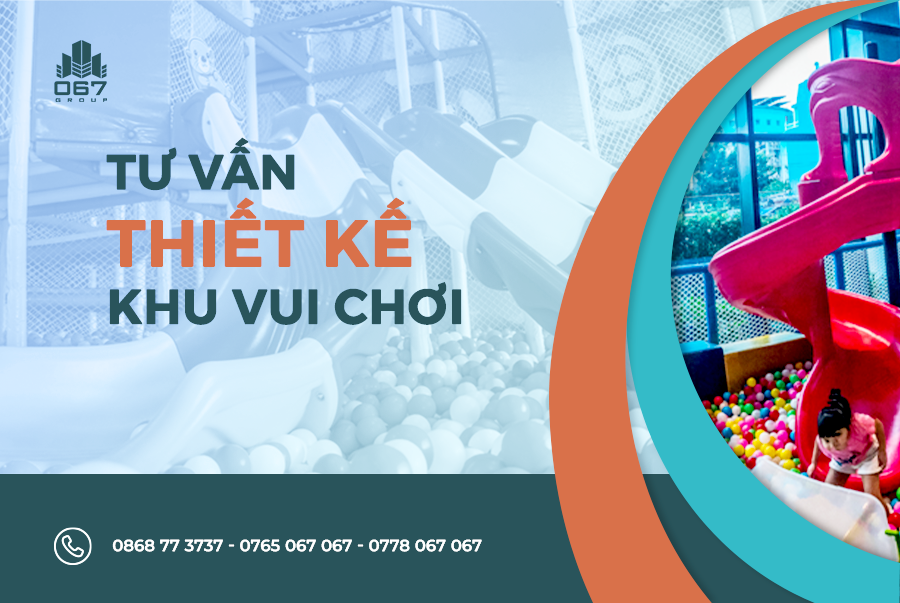
Indoor schemes avoid weather exposure, drainage and UV degradation, and they often use vertical space, so a 100m2 footprint can deliver more play events through a multi-level structure. In exchange, the budget absorbs building services: lighting, ventilation, air conditioning, fire detection, ceiling clearance works and slab loading checks. Softer materials shorten the wear cycle on netting and padding, and cleaning is a heavier operating line.
Outdoor
Outdoor schemes carry groundworks, drainage, shade and weather-resistant specification. Materials must survive intense sun and prolonged humidity, which pushes the specification toward galvanised and powder-coated steel, UV-stabilised HDPE and stainless fixings. Surfacing must drain. Set against that, outdoor sites usually avoid rent-driven building services and can be extended more cheaply later.
A sensible equipment mix for 100m2
Resist filling the area. Circulation, queuing space and supervision sightlines are part of the design, and impact areas around each item cannot overlap where the standards prohibit it. A workable mix balances one anchor item against several supporting ones.
- One multi-function play structure as the anchor: platforms, a slide, a climbing route and an enclosed element.
- A toddler zone kept physically separate, with low deck heights and its own soft surfacing.
- Two or three independent items for turnover: spring riders, a small climber, a balance element.
- A quiet or sensory element, which extends dwell time and supports inclusive use.
- Adult seating with clear sightlines to every zone.
- Storage for cleaning equipment, spares and first aid.
For layout principles by venue type, see our guides to indoor playground design and safety surfacing options.
Frequently asked questions
Is 100m2 enough for a commercial play area?
Yes, provided the layout is disciplined and the catchment supports it. Small venues trade well where footfall is high and the offer is focused on a clear age band. Problems arise when operators overfill the space, which compromises impact areas, circulation and supervision sightlines, and makes the venue feel crowded at moderate occupancy.
Why does surfacing sometimes cost as much as the equipment?
Because it is engineered, not decorative. Impact attenuating surfacing must be specified and tested to the critical fall height of the equipment above it, and that determines system thickness and construction. Add sub-base preparation and drainage, and the installed cost of the surfacing package can approach or exceed the equipment package.
How should maintenance be budgeted?
Provision an annual amount from the first year rather than reacting to failures. It should cover scheduled inspections, wear items, cleaning consumables and a sinking fund for surfacing repair. Ask the supplier for expected service life and a spare parts list at tender stage so the figure is grounded in the actual specification.
Can the play area be extended later?
Plan for it at the outset. Leave a defined expansion zone, keep the surfacing system and colour range documented, and choose a supplier likely to hold compatible parts in future. Retrofitting into a fully built-out 100m2 children’s play area usually means removing an existing item and reworking impact areas.
Talk to 067 Group
067 Group consults on, designs, supplies and installs children’s play equipment, outdoor fitness equipment and safety surfacing for developers, schools, hotels and municipal clients. Our working process begins with a requirements and budget discussion, then a site survey, concept design, installation and scheduled maintenance during the warranty period.
Vietnam office: No. 38 Ven Ho Ha Dinh, Ha Dinh ward, Thanh Xuan district, Hanoi. Telephone +84 24 66 73 3777 or +84 24 66 73 9777. Send a dimensioned plan of the space and the age groups you intend to serve, and we will return a layout, a specification and a scope breakdown you can put out to tender.