
 Share
SharePlayground Equipment for Hotels and Resorts
Why Resort Play Areas Fail Faster Than Any Other Site
A resort play area works ten hours a day for guests who paid for the experience, then sits in salt air and ultraviolet light. Specifying playground equipment for hotels is therefore a durability and liability problem before it is a design one. This guide covers what to get right.
The failures are predictable. Corroded fasteners within two seasons on a beachfront site. A slide exit landing on wet tile. A single play structure sized for eight year olds while half the guest children are three. None of these are manufacturing faults. They are specification decisions made without asking who actually uses the area and in what conditions.
Start With Guest Demographics and Dwell Time
Before any layout is drawn, the operator needs to answer two commercial questions, because the answers change the equipment list completely.
Who are the children on site?
A city business hotel with occasional family weekends is not a beach resort where two thirds of arrivals are families with children under six. Pull the data you already hold: booking profiles by room type, school holiday occupancy, average party size, and repeat family bookings. A property whose guest mix skews toward toddlers needs a low, dense, shaded play area with parent seating in arm’s reach, not a tall net climber.
How long do children stay in one place?
Dwell time drives value. If parents use the play area for twenty minutes while a table is prepared, you need visibility from the restaurant terrace and quick engagement. If it is a two hour afternoon activity while parents use the spa, you need supervised zones, shade, water access and enough variety that a child does not exhaust the equipment in ten minutes. Variety here means different types of play, not more of the same: climbing, sliding, rocking, balancing, sand or water play, and a quiet corner.
Kids club indoors versus open air play
Most properties end up with both, and the split should be deliberate rather than accidental.
An indoor kids club buys you weather independence, controlled supervision, and usable hours through the hottest part of the day and through the rainy season. It costs you floor area that could earn revenue, and it needs staff on shift whenever it is open. Soft play, padded flooring and enclosed structures suit it.
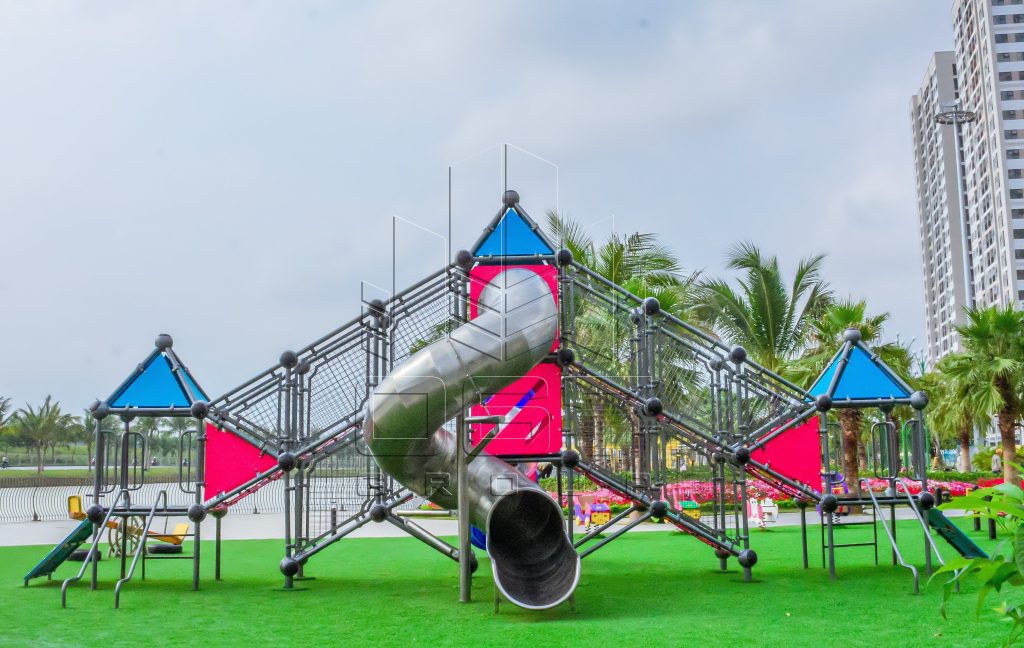
Open air play buys you scale, natural light and a visible amenity that photographs well for marketing. It costs you exposure: sun, rain, salt and wind all attack the installation, and surface temperature becomes a real safety issue on metal slides and dark rubber surfacing in the middle of the day. In Vietnam the practical answer on most coastal and southern properties is a shaded outdoor area used morning and late afternoon, plus an indoor room that carries the midday and monsoon load.
Beach and Pool Adjacency, Salt Air and Ultraviolet
Placing a play area near the pool or the beach is commercially obvious and technically demanding. Three issues need to be settled at specification stage.
Corrosion
Salt laden air attacks steel, fasteners and cable terminations far faster than an inland site. Ask suppliers for the corrosion protection specification in writing rather than accepting the word “galvanised”. Hot dip galvanising plus a powder coat topcoat, stainless fixings of an appropriate grade, sealed post ends, and non ferrous or fully encapsulated bearings are the sort of detail that decides whether the installation looks acceptable in year five. Timber and high density polyethylene panels generally cope better with salt than untreated steel, but timber still needs the right species and detailing at ground line.
Ultraviolet and surface temperature
Strong sunlight fades colour, embrittles some plastics and degrades rope. Ask what ultraviolet stabilisation the plastics and ropes carry and what the colour fastness expectation is. Separately, measure the problem you cannot see on a drawing: an exposed dark surface or a metal slide bed in full afternoon sun can become too hot to touch. Shade sails, tree canopy or a roofed structure over the main play items are not decoration on a tropical site.
Sand, drainage and wet feet
Children arrive wet from the pool or the sea and bring sand with them. Design for it: falls to drain across the whole impact area, no ponding, an accessible edge detail that lets sand be swept rather than trapped, and a rinse point on the route between water and play.
Specification Checklist for Playground Equipment for Hotels and Resorts
Work through this list with your designer and your supplier before the tender goes out. Every line has caused a rebuild somewhere.
- Age zoning. Separate areas for approximately 1 to 3, 3 to 6 and 6 to 12 year olds, with equipment scaled to each and clear signage. Mixed age crowding is the most common complaint from parents.
- Fall height and surfacing. Confirm the critical fall height each area is designed for and that the surfacing has been tested to match it. EN 1177 is the reference for impact attenuating surfacing and critical fall height, and ASTM F1292 is the equivalent American approach.
- Wet area surfacing. Near pools and showers choose a system that stays slip resistant when wet, drains freely and does not hold algae. Poured rubber and EPDM systems generally suit wet adjacency better than loose fill, which migrates and clumps.
- Sight lines. Supervising adults should see the whole area from seating, from the pool deck and, where relevant, from the lifeguard position. No blind interiors under decks.
- Shade. Shade over the main play items and over the parent seating, checked against the sun path at 11:00 and 15:00, not only at noon.
- Corrosion specification. Written coating system, fastener grade and bearing type, plus the supplier’s stated maintenance interval for coastal sites.
- Free space and falling space. Confirm clearances around every item against EN 1176 and check nothing is later placed inside them: planters, loungers, umbrellas and signage all creep in.
- Access and egress. Gated where children could run toward a road, a pool edge or a car park. Self closing latches that staff can operate one handed.
- Operating hours. Decide opening and closing times, whether lighting is provided, and how the area is closed when unsupervised.
- Documentation. Manufacturer manuals, layout drawing, surfacing test certificate, installation record and spare parts list, all handed over on completion.
Supervision, Liability and Operating Hours
Hotels carry a duty of care that a public park does not, because the guest is a paying customer on your premises. Three practical positions reduce exposure.
First, decide explicitly whether the area is supervised or parent supervised, then say so on signage and in the guest information, and behave consistently. A half supervised area, staffed at some hours and not at others without any signal to guests, is the worst of both.
Second, run and record inspections. The three level approach described in EN 1176-7, which covers installation, inspection, maintenance and operation, adapts directly to hotel operations: a routine visual check before opening every day, an operational check monthly, and an annual main inspection by a competent inspector. Our playground equipment maintenance checklist sets out what each level should cover.
Third, keep the paperwork. If an incident occurs, the questions will be what the area was designed for, when it was last inspected, who inspected it and what was found. An inspection you cannot evidence counts as an inspection that did not happen.
Maintenance Under Seasonal Footfall and the Renovation Window
Two operational realities separate hotel projects from every other sector: usage is violently seasonal, and the work has to fit a closure window.
Peak season wear
An area that sees light use for months can take a full year of wear in one holiday peak. Move the maintenance cycle to match: tighten inspection frequency during peak occupancy, hold consumable spares on site before the season rather than ordering them during it, and schedule the heavier work into the shoulder season. Consumables worth stocking are swing bearings and chains, rope terminations, slide bed fixings, and matching surfacing material for patch repairs.
Procurement against a renovation window
Playground packages are frequently the last item added to a refurbishment programme and the first to slip. Build the timeline backwards from the reopening date and allow for concept design and approval, manufacture, shipping and customs where equipment is imported, foundation works and curing, surfacing installation with its own cure and weather requirements, then inspection and handover before guests arrive. Surfacing in particular cannot be rushed: poured systems need dry conditions and cure time, and forcing them into a wet week produces a finish you will replace. Anyone specifying playground equipment for hotels on a fixed reopening date should agree the critical path with the supplier before signing, not after.
067 Group works to a defined sequence of requirement and budget discussion, site assessment and measurement, design concept, contract, installation and then scheduled maintenance every three months during the warranty period, with project records retained for warranty and maintenance. Hotel, resort and residential examples are shown on our projects page, and the residential equivalent of this brief is covered in our guide to playground equipment for apartment buildings in Vietnam.
Frequently Asked Questions
What standards apply to playground equipment for hotels in Vietnam?
International properties usually specify to EN 1176 for equipment and EN 1177 for impact attenuating surfacing, or the American equivalents ASTM F1487 and ASTM F1292. Vietnam has its own TCVN 12730 series for playground equipment. Agree which framework applies before tender, and require test evidence rather than a general claim of compliance.
Should a resort play area be fenced?
Fence playground equipment for hotels where a child leaving unnoticed could reach a hazard: a road, a car park, an unfenced pool edge or open water. Otherwise a defined edge, planting and clear sight lines often work better, because they keep supervising adults engaged. Where you do fence, use self closing gates and keep the whole area visible from outside.
How long does a hotel playground project take?
Plan in months rather than weeks. Concept design and approval, manufacture, delivery including customs on imported items, foundations, surfacing installation with cure time, then inspection and handover. Surfacing and weather are the usual critical path. Starting the conversation early in the renovation programme is the single most effective way to protect a reopening date.
What surfacing suits a play area next to a pool?
A bonded system such as poured rubber or EPDM is normally preferred next to water because it drains, stays slip resistant when wet, and does not migrate the way sand or bark does. Confirm the thickness has been tested for the critical fall height of the tallest item, and check the detail where the surfacing meets pool deck tiling.
Talk To Us About Your Property
If you are planning a new family amenity or replacing a tired one, 067 Group provides consultancy, design, supply and installation of playground equipment, outdoor fitness equipment and safety surfacing, and works to ISO 9001:2015, ISO 14001:2015 and ISO 45001:2018 management systems. Background reading on compliance is in our playground equipment safety standards guide.
Reach us in Hanoi at No 38 Ven Ho Ha Dinh street, Ha Dinh ward, Thanh Xuan district, on +84 24 66 73 3777 or +84 24 66 73 9777. Bring your site plan, your occupancy profile and your reopening date, and we will work back from there.