
 Share
ShareKindergarten Playground Equipment and TCVN Requirements
Why Kindergarten Playground Equipment Needs Its Own Specification
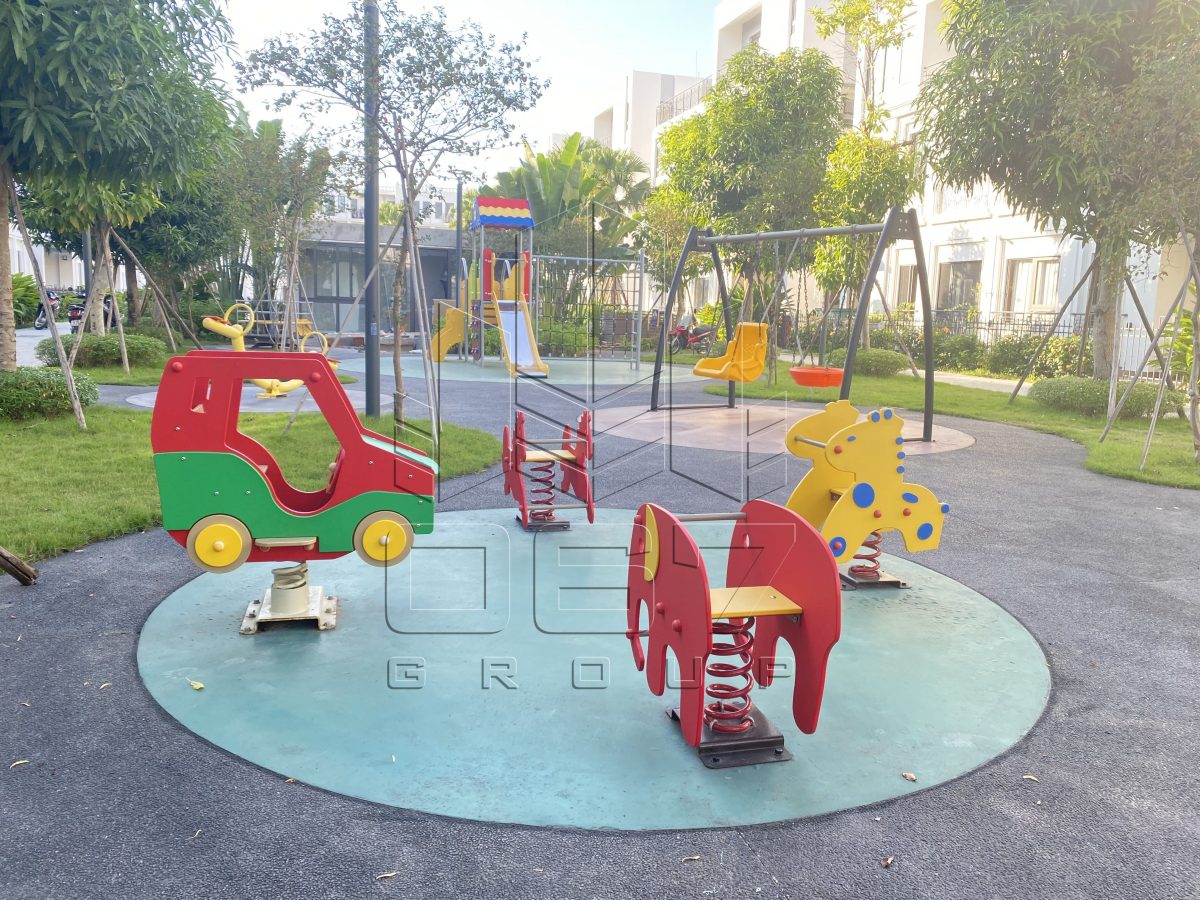
Most play areas sold to Vietnamese preschools were designed for primary school children. Kindergarten playground equipment has to suit bodies aged two to six, which changes reach, grip, fall height and entrapment risk. This guide sets out what a director should specify, demand at handover and check during term.
The difference is not cosmetic. A two year old has a head circumference that is large relative to the body, weak upper body strength, an incomplete sense of risk and a habit of putting limbs into any gap. Equipment scaled for a nine year old fails all four of those realities at once, and it usually fails quietly until a child is hurt.
Age Band 2 to 6 and Why Bigger Equipment Is Wrong
Manufacturers design to age bands because children’s dimensions and abilities change sharply. Buying up an age band to “get more years out of it” is the most common and most expensive mistake a school makes.
Reach, grip and step geometry
A toddler cannot span the rung spacing or grip the handrail diameter of a structure built for older children. The result is a child who can climb up but not down, or who reaches a platform edge with no handhold at the point of maximum need. Steps should be shallower and closer together, handrails thinner and placed lower, and platforms should have guardrails or barriers appropriate to the height and the age.
Fall height
Free height of fall is the single most important number in kindergarten playground equipment. For the youngest users, keep it low. Equipment intended for toddlers usually sits well under one metre of free fall height, while items for the four to six band are typically kept modest rather than pushed toward the limits allowed for older children. Lower fall heights also reduce the surfacing thickness required, which reduces cost.
Speed and momentum
Long straight slides, fast rotating items and large swing arcs deliver energy that a small child cannot manage. Prefer wide short slides where a teacher can assist at the exit, low rockers with damped movement, and cradle style swing seats with proper support for the youngest users.
Entrapment, Finger Traps and Small Body Hazards
The hazard categories in EN 1176 exist because of documented injury patterns, and small children encounter almost all of them.
Head and neck entrapment
Openings must either be small enough that a head cannot enter or large enough that it passes through freely. The dangerous zone is the middle, and it appears in gaps between platform and barrier, in rung ladders, in net mesh, and in decorative panel cut outs. Any V shaped gap that narrows downward is a neck trap. Suppliers should be able to state that the equipment has been assessed with the standard entrapment probes, not merely that it looks safe.
Finger entrapment and shear points
Small fingers enter small holes. Watch for drainage holes in slide beds and platforms, gaps at chain links and connectors, the junction between moving and fixed parts on rockers and roundabouts, and worn bolt caps that leave a thread exposed. Chain links on toddler swings are often sleeved or of a closed type for exactly this reason.
Clothing entrapment and protrusions
Cords, hoods and the toggles on Vietnamese school uniforms catch on protruding bolts, open hooks and gaps at slide entries. Slide entry sections should have no protrusion above the bed, and every fastener should be capped or domed.
TCVN 12730, EN 1176 and EN 1177 in Practice
Vietnam has its own standard series for playground equipment, TCVN 12730, of which TCVN 12730-1:2019 sets out general safety requirements and test methods. Its structure and technical approach follow the international playground safety framework closely, which is why a supplier who can demonstrate compliance with EN 1176 for equipment and EN 1177 for impact attenuating surfacing is usually well placed against TCVN as well.
For a school director the practical implications are simple. Write the standard into the purchase documents rather than leaving it to be argued later. Ask which parts apply to the items you are buying, since EN 1176 is a multi part standard covering general requirements plus specific item types such as swings, slides, cableways, roundabouts, rocking equipment and ropes. Ask for evidence in the form of test or certification documents that name the actual product, not a generic company brochure claiming compliance. And remember that EN 1176-7 covers installation, inspection, maintenance and operation, which is the part that becomes your responsibility the day the installer leaves site. A broader overview is in our playground equipment safety standards guide.
Surfacing, Critical Fall Height, Shade and Layout
Equipment is only half the specification. The ground under it, the sun above it and the way the space is arranged decide how safe the area actually is in daily use.
Surfacing and critical fall height
Every impact attenuating surface has a critical fall height, the height up to which it has been tested to attenuate a fall. The rule is that the critical fall height of the surface must equal or exceed the free height of fall of the equipment above it, across the whole impact area including the sides and the run out of slides and swings. Poured rubber and EPDM thicknesses typically run in the range of 20 to 60 mm or more depending on the fall height being protected, and loose fill such as sand needs a substantial maintained depth. Ask for the test document that ties the specific surface build up to a stated critical fall height. Our comparison of playground safety surfacing options covers the trade offs in detail.
Shade and heat
In most of Vietnam, an unshaded preschool play area is unusable for a large part of the day and dark surfacing can reach uncomfortable surface temperatures. Plan shade over the main play items and over the area where teachers stand, and check the sun path in the late morning and mid afternoon rather than only at noon. Light coloured surfacing in exposed positions and drinking water within easy reach are cheap additions that extend usable hours.
Layout for supervision sight lines
One teacher should be able to see the whole area from a normal standing position. Keep tall items at the perimeter and low items in the middle rather than the reverse, avoid enclosed spaces under decks that a child can hide in, and keep planting below adult eye level. Position the gate so that a child cannot reach it without passing an adult, and separate wheeled toy routes from the fall zones around fixed equipment.
Handover Documentation and Term Time Inspection
The two things that most often go wrong after a good installation are missing paperwork and no inspection routine. Both are avoidable and both are the school’s responsibility to insist on.
What to demand at handover
- Layout drawing showing every item with its free height of fall, impact area and free space.
- Product documents or certification for each item, naming the product and the standard applied.
- Surfacing specification with the tested critical fall height and installed thickness for each zone.
- Installation record including foundation type, depth and concrete details.
- Manufacturer operation and maintenance manuals in a language your staff read.
- Inspection checklists for the routine, operational and annual levels, with recommended frequencies.
- Spare parts list with part numbers and lead times, plus the warranty terms and what voids them.
- An on site briefing for the caretaker and at least one teacher on what a daily check looks like.
Inspection routine during term
Run a routine visual check every school day before children go out: broken or missing parts, loose fasteners, sharp edges, standing water, litter and foreign objects in the impact area, surfacing displaced around posts and slide exits. Add a monthly operational check with tools, covering moving parts, chain and rope wear, foundation exposure and surfacing depth. Book an annual main inspection by a competent inspector, ideally in the school holidays so that repairs can be done before term. After a storm or flooding, inspect before reopening the area rather than after.
067 Group follows a set sequence of requirement and budget discussion, site assessment and measurement, design concept, contract, installation and then scheduled maintenance every three months during the warranty period, with project records retained so warranty and maintenance history stays traceable. That sequence is described on our process page.
Frequently Asked Questions
What standard applies to kindergarten playground equipment in Vietnam?
The Vietnamese reference is the TCVN 12730 series, with TCVN 12730-1:2019 covering general safety requirements and test methods. Its approach follows the international framework, so suppliers commonly demonstrate conformity with EN 1176 for equipment and EN 1177 for surfacing. Name the standard in your purchase documents and ask for product specific evidence.
Can we buy one structure for ages 2 to 12?
It is rarely a good idea. Reach, grip diameter, step spacing, barrier requirements and safe fall heights differ substantially between toddlers and older children, so a combined structure usually compromises the youngest users. Specify kindergarten playground equipment as its own zone, clearly signed and physically distinct from the older age band.
How thick should the safety surfacing be?
Thickness follows the free height of fall, not preference. The surface must have a tested critical fall height equal to or greater than the highest fall from the equipment above it. Bonded rubber systems typically fall in the range of 20 to 60 mm or more as fall height increases. Always ask for the test document that supports the figure.
How often should a preschool inspect its play area?
Visually every school day before use, an operational check with tools monthly, and a full annual main inspection by a competent inspector, preferably during a holiday. Inspect immediately after storms, flooding or any reported incident. Keep the signed sheets, because an inspection with no record is difficult to rely on afterwards.
Talk To Us About Your School
If you are planning a new preschool play area, replacing equipment that no longer suits your age groups, or reviewing what an existing installation actually complies with, 067 Group provides consultancy, design, supply and installation of children’s playground equipment and safety surfacing, working to ISO 9001:2015, ISO 14001:2015 and ISO 45001:2018 management systems. School specific selection criteria are covered in our guide to outdoor playground equipment for schools.
Reach us in Hanoi at No 38 Ven Ho Ha Dinh street, Ha Dinh ward, Thanh Xuan district, on +84 24 66 73 3777 or +84 24 66 73 9777. Send your site dimensions, your class age groups and your available budget range, and we will start from what will actually fit.