
 Share
SharePlayground Equipment Safety Standards: A Buyer’s Guide
Why Safety Standards Decide the Quality of Your Playground
Most playground disputes are not about colour or price. They are about whether the installation actually meets the playground equipment safety standards the contract promised. This guide explains the standards that matter, how to write them into a specification, and how to check compliance before you sign off a handover.
A playground is a piece of public infrastructure that children use unsupervised, at speed, in ways the designer never imagined. That is exactly why the standards exist. They convert decades of accident data into measurable rules: how wide a gap may be, how high a platform may sit above its surfacing, how much force a swing seat may transmit. When a supplier says a product is safe, the only meaningful question is which standard it was tested against and who tested it.
The Standards Framework You Need to Know
Four families of documents cover almost every project in Vietnam and the wider region. A specifier does not need to memorise clause numbers, but does need to know what each document controls.
EN 1176: Playground Equipment and Surfacing
EN 1176 is the European reference and the one most commonly written into developer and hotel specifications in Vietnam. It is published in parts. Part 1 sets the general safety requirements that apply to all equipment: entrapment of head, neck, fingers and clothing, protrusions, structural integrity, materials, and the extent of the free space around equipment. Later parts add requirements for specific equipment families, including swings, slides, ropeways, carousels, rocking equipment, fully enclosed play equipment, spatial networks and similar structures. Part 7 covers installation, inspection, maintenance and operation, which is the part most often ignored and most often the reason an installation degrades within two years.
The concepts a buyer should recognise from EN 1176 are falling height, free space and impact area. Falling height is the greatest vertical distance from the intended body support to the surface below. Free space is the volume around the equipment that a user may occupy while moving, which must be kept clear of obstructions. The impact area is the surface region that must be impact attenuating. Every one of these has direct cost consequences, because they set the minimum footprint and the minimum surfacing thickness.
EN 1177: Impact Attenuating Surfacing
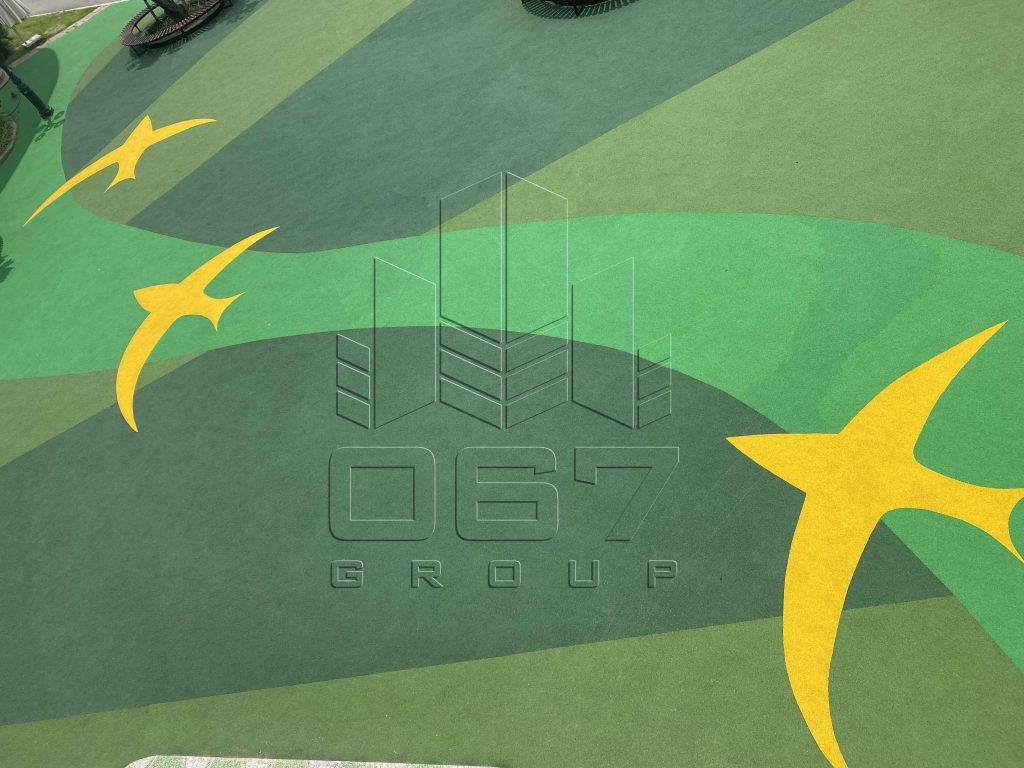
EN 1177 is the companion standard for surfacing. It defines how the critical fall height of a surface is determined by test, dropping an instrumented headform and measuring the deceleration. The result is a critical fall height in metres, and the rule is simple: the critical fall height of the installed surface must be equal to or greater than the falling height of the equipment above it. This is the single most useful number a buyer can ask for, and the most commonly missing document in a submittal package. Practical thicknesses for bonded rubber and EPDM systems typically run from around 20 mm for very low equipment up to 60 mm or more where fall heights are significant, but the thickness is only valid together with a test report for that specific system build-up. Our comparison of EPDM and rubber tile safety surfacing goes into the material choice in detail.
ASTM F1487, ASTM F1292 and the CPSC Handbook
American-specified projects, and many international hotel brands, reference ASTM F1487 for public use playground equipment and ASTM F1292 for impact attenuation of surfacing. The CPSC Public Playground Safety Handbook is not a standard but a guidance document, widely used because it is readable and practical. The American and European frameworks reach similar safety outcomes through different test methods, so mixing them inside one specification creates confusion. Choose one framework as the primary reference and note the other as an accepted equivalent if you need to keep the tender open to more suppliers.
TCVN 12730: The Vietnamese Standard Series
Vietnam has its own national standard series for playground equipment, TCVN 12730, with TCVN 12730-1:2019 covering general safety requirements and test methods. It is closely aligned in intent with the European approach. For public and municipal work in Vietnam, referencing the TCVN series alongside EN 1176 is the cleanest way to satisfy both local review and international design teams.
How to Write Playground Equipment Safety Standards Into a Specification
Vague wording is the root of most compliance failures. “Equipment shall comply with international safety standards” is unenforceable. Use language that names the document, names the evidence, and names who must supply it.
- Name the standard and the part. For example, equipment to EN 1176 with the relevant part for each equipment type, surfacing to EN 1177.
- Require the test report, not a logo. Ask for the report or certificate from an accredited third party laboratory or certification body, with the report number, date and the exact product reference tested.
- Require a declared critical fall height for the proposed surfacing build-up, and require it to cover the highest falling height on the site.
- Require an as-built layout drawing showing free space and impact areas for every item, so the areas can be checked against the actual site dimensions.
- Require installation to the manufacturer’s instructions including foundation details, and require those instructions to be handed over.
- Require a post-installation inspection and a documented handover, plus the operator inspection regime described below.
- Require a quality management framework from the supplier. An ISO 9001:2015 certified supplier with ISO 14001:2015 and ISO 45001:2018 in place is evidence of process control on the manufacturing and site sides, not only of product testing.
Compliance Checklist for Submittals and Handover
| Item to verify | Evidence you should receive | Stage |
|---|---|---|
| Equipment safety compliance | Third party test report or certificate referencing EN 1176, ASTM F1487 or TCVN 12730 for each product | Submittal |
| Surfacing impact attenuation | Critical fall height test report to EN 1177 or ASTM F1292 for the exact build-up and thickness | Submittal |
| Falling height versus surfacing | Schedule listing each item, its falling height and the surfacing critical fall height beneath it | Submittal |
| Free space and impact areas | Dimensioned layout drawing with clearances marked, checked against site survey | Design |
| Materials and finishes | Material specifications, coating system, fastener grade, hardwood or steel treatment details | Submittal |
| Foundations | Foundation drawings and confirmation that footings are below surfacing level as required | Installation |
| Entrapment and protrusion | Post-installation inspection record confirming gaps, openings and projections checked | Handover |
| Operation and maintenance | Manual with inspection frequencies, spare part references and warranty terms | Handover |
| Signage | Age range, capacity and emergency contact information displayed at the play area | Handover |
Where Compliance Usually Breaks Down on Site
Certified equipment installed badly is not a compliant playground. These are the recurring problems worth watching for during installation.
Surfacing installed thinner than tested
A surface tested at one thickness does not perform at a lower thickness. Thickness must be checked across the impact area, not only at the edges where it is easy to measure.
Free space eroded by landscaping
Benches, planters, low walls, tree trunks, lighting poles and drainage grates get added after the play layout is fixed and end up inside a free space or impact area. Coordinate the play layout with the landscape package early.
Equipment crowded together to save space
Overlapping impact areas between items with movement, such as swings and rocking equipment, is a classic tender-stage compression that has to be resolved by reducing the equipment count, not by ignoring clearances.
No inspection regime after handover
EN 1176 expects routine visual inspection, more detailed operational inspection at intervals, and an annual main inspection. Without a written regime and a named responsible person, loose fixings and worn bearings accumulate. A practical playground equipment maintenance checklist is the simplest way to make this stick.
Substitution after award
Products swapped for cheaper equivalents after contract award, with the original certificates left in the file. Require re-submittal of test evidence for any substitution.
Standards, Budget and Programme
Safety standards are usually treated as a cost item. In practice they are a programme item. Getting the falling heights, free spaces and surfacing thicknesses right at concept stage costs nothing. Discovering at installation that the impact areas do not fit the available footprint means redesign, re-order and delay. This is why a disciplined sequence matters: requirement and budget discussion, site assessment and measurement, design concept, contract, installation, then scheduled maintenance. You can see how 067 Group structures that sequence on our project process page, and the same logic is set out step by step in our guide to planning a playground project from brief to handover.
Frequently Asked Questions
Is EN 1176 mandatory in Vietnam?
EN 1176 is a European standard, so it applies in Vietnam through the contract rather than through law. Vietnam has its own series, TCVN 12730, with TCVN 12730-1:2019 covering general safety requirements. Many developers and international operators specify EN 1176 as well, and referencing both is common practice on larger projects.
What is the difference between EN 1176 and EN 1177?
EN 1176 covers the equipment itself: geometry, entrapment, structure, materials, installation and inspection. EN 1177 covers the surfacing beneath the equipment and defines how the critical fall height of a surface is determined by test. You need both, because compliant equipment over untested surfacing is still an unresolved fall risk.
How do I check surfacing depth without destructive testing?
Ask for the installer’s thickness records taken during pouring or laying, at gridded points across the impact area, with photographs. Core sampling at a small number of agreed locations is the usual verification method, with the cores repaired afterwards. Both should be written into the contract before installation starts.
Do outdoor fitness machines fall under the same standard?
No. Permanently installed outdoor fitness equipment is covered by EN 16630, which addresses adult users and different loading and access conditions. If your project combines a play area and a fitness zone, both standards need to appear in the specification. Our outdoor fitness planning guide covers this in more detail.
Talk to 067 Group About Your Specification
067 Group provides consultancy, design, supply and installation of children’s playground equipment, outdoor fitness equipment and safety surfacing, and we are happy to review a draft specification or a layout before it goes to tender. If you would like to discuss a project, contact our Hanoi office at No 38 Ven Ho Ha Dinh street, Ha Dinh ward, Thanh Xuan district, Hanoi, on +84 24 66 73 3777 or +84 24 66 73 9777, or use the contact page. You can also browse our completed projects to see how these requirements are handled in practice.