
 Share
Artificial Grass vs Rubber for Play Areas
The Surface Is the Safety Decision
Most playground tenders specify the equipment first and the ground last, then discover the two decisions are not independent. Choosing between artificial grass for play areas and rubber surfacing changes the safety case, the drainage design, the maintenance budget and the price. This article compares the two on the criteria that actually decide the outcome.
Both options are legitimate. Rubber surfacing, whether poured EPDM or prefabricated tiles, is the default safety surface under equipment. Artificial grass is a landscape product that can double as a play surface when specified with the right underlay and tested to the right fall height. The error is treating them as interchangeable, or choosing one on appearance alone. What follows is a comparison on the axes a buyer actually signs for: safety, durability in a tropical climate, installation, maintenance and relative cost.
How Each Surface Is Built
What goes under the grass
A play-grade grass system is not a mat on a slab. It is a build-up: a prepared base, usually compacted aggregate or a jointed concrete pad with drainage; a shock pad or underlay in some specifications; the grass carpet itself, tufted yarn bonded to a backing; and an infill, typically silica sand with some rubber granule, brushed into the pile. Each layer changes the result. The same carpet on a solid slab and on a granular base with a shock pad behaves differently under a fall, drains differently after rain, and ages differently in heat. When you compare quotes, compare build-ups, not carpet prices.
What goes under the rubber
Rubber surfacing is a two-layer system in its own right. The lower layer is a shock pad of recycled rubber granules bound with polyurethane; the upper layer is a wear course, either poured EPDM granules or factory moulded tiles. Total thickness is set by the required critical fall height and typically ranges from about 20 mm for low equipment to 60 mm or more where falls are significant. Because the system is engineered around impact, its performance is defined by test rather than by appearance. Our article on poured EPDM versus rubber tiles covers the two rubber routes in detail.
Safety: Impact Attenuation and Critical Fall Height
The rule that governs the whole decision is simple: the surface under equipment must have a tested critical fall height that meets or exceeds the falling height of the equipment above it. Falling height is measured from the highest intended body support, not from the top of the structure. EN 1177 defines how critical fall height is determined for surfacing and is the basis of the TCVN 12730-1:2019 series in Vietnam; ASTM F1292 plays the same role in the US system, and the CPSC Public Playground Safety Handbook repeats the point for public playgrounds.
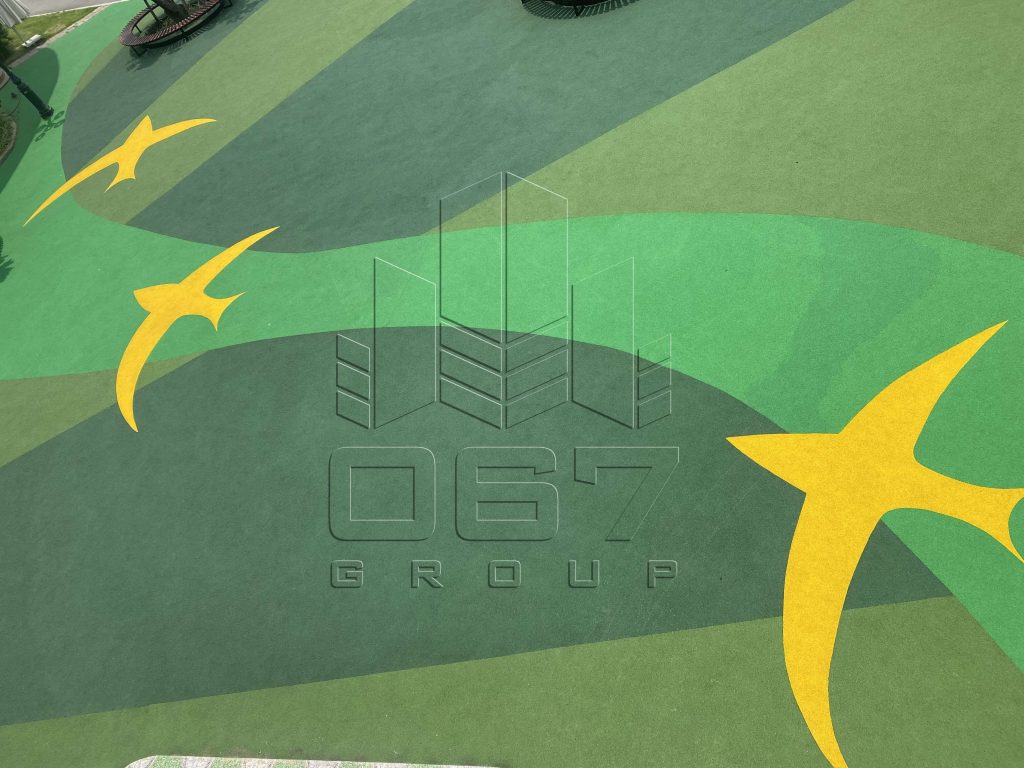
Where the two materials diverge is in what the test actually measures. A rubber system is tested as a system: shock pad plus wear layer at a stated total thickness. A grass system, where it is tested at all, is tested as the full build-up: carpet, infill, underlay and base. Grass is a firmer surface. It attenuates impact less per millimetre than a rubber shock pad, so a grass build-up that matches a given fall height usually needs more total thickness, a better base, or both. In practice that means grass is most often specified for general play zones and for equipment with modest falling heights, while rubber takes the impact zones under swings, climbers and slides.
If grass is specified under any equipment, the submittal pack should contain:
- A test report to EN 1177 or ASTM F1292 for the exact grass build-up, including carpet specification, infill type and depth, underlay thickness and base condition.
- A schedule of every equipment item, its falling height, and the surface specified beneath it.
- Evidence that installed thickness and infill depth will be verified at handover, since a grass system tested at one infill depth does not perform at another.
- A statement of surface firmness, since a surface that is too firm or too soft reduces the effective fall height.
Artificial Grass for Play Areas: When It Makes Sense
Artificial grass for play areas wins on appearance, not on impact protection. That is not a defect; it is the boundary of the product. Where it fits:
- Landscape continuity. Schools and residential compounds that want the play area to read as garden, not as a rubber mat, specify grass in the zones away from equipment.
- Low falling heights. Equipment with modest falling heights, where a tested grass build-up can cover the requirement, is the honest use case.
- Perimeter and circulation zones. Grass around the edge of a rubber impact zone softens the visual transition and keeps the play area feeling larger.
- Sites where drainage detail is already solved. Grass tolerates a well-drained base well; it punishes a base that holds water.
Tropical Durability: UV, Rain, Drainage and Heat
Safety decides whether a surface may sit under equipment at all. Climate decides whether it still performs in year five. That second question is where the case for artificial grass for play areas is won or lost in a tropical city.
UV and colour
Both materials age in sun, but differently. EPDM is a synthetic rubber with strong UV stability, so a poured rubber surface keeps its colour for a long time. Grass yarn, usually polyethylene or polypropylene, yellows and fades under sustained UV even with stabilisers; the infill darkens with organic build-up. Neither failure is structural, but a faded grass field next to a crisp rubber zone reads as neglect, and that is a maintenance budget issue, not a product issue.
Rain and drainage
In a monsoon climate, standing water is the real enemy of both surfaces. Under rubber, water softens the base, lifts tile joints and feeds algae at the edges. Under grass, trapped water breeds odour, compacts the infill and accelerates yarn fatigue. Both systems need a base with a positive fall to a real drainage outlet, and both need the outlet verified at handover. A surface that drains well in the dry season can still fail in the first heavy rain if the fall is wrong.
Heat underfoot
Both surfaces get hot in direct sun, and the honest answer to ‘which is cooler’ is: it depends on colour, infill and shade. Dark rubber is the worst case; light tones and shade structures help more than material choice. Grass with a granular infill usually sits cooler than a dark rubber mat, but a dark infill under a clear sky changes that. Plan shade where children sit and lie, and specify light tones for large open areas, whichever material you choose.
Installation, Maintenance and Relative Cost
The two systems are installed by different trades and fail in different ways, so the comparison should run on the full lifecycle, not on the square metre rate. The table below is the working version of that comparison.
| Criterion | Artificial grass | Rubber (poured EPDM or tiles) |
|---|---|---|
| Safety role | General play zones; under equipment only with a tested build-up | Default safety surface under equipment at any falling height |
| Critical fall height | Lower per millimetre; needs more build-up to match a given height | Set by tested total thickness, typically 20 to 60 mm by zone |
| Base demand | Level, well-drained base; concrete pad or compacted aggregate | Permeable, graded base with positive fall; defects telegraph through |
| Installation | Carpet laid and bound, infill applied; less weather sensitive than wet rubber | Wet mixing and curing for poured systems; tiles are faster and phaseable |
| Heat | Usually cooler underfoot in light tones; infill colour matters | Heats in sun; dark tones worst, light tones and shade help |
| UV ageing | Yarn fades and yellows over time; infill darkens | EPDM is UV stable; colour holds |
| Drainage | Drains through backing and base; standing water breeds odour | Permeable when correctly laid; standing water softens base |
| Routine maintenance | Brushing, infill top-up, debris removal and washing | Cleaning, edge and joint checks, patching |
| Repair | Localised replacement of carpet sections; colour match is the risk | Tiles replace cleanly; poured EPDM patches are harder to match |
| Best fit | Landscape-led sites, low fall heights, perimeter zones | Impact zones, high use, accessibility, phased works |
Two cost structures are worth understanding before you compare quotes. Rubber cost is driven by the shock pad thickness map: every additional falling height zone adds material across the whole zone, and the base work is usually the larger hidden item. Grass cost is driven by the base: a concrete pad with drainage is a civils package in its own right, and the infill and underlay are recurring line items that quotes sometimes omit. A like-for-like comparison means putting both options on the same base specification and the same drainage scope.
For budgeting the whole project, including equipment, the playground investment cost planning guide covers how to structure the estimate so surfacing is not the line item that gets squeezed.
Frequently Asked Questions
Can artificial grass be used directly under playground equipment?
Only when the complete build-up, carpet, infill, underlay and base, has a tested critical fall height to EN 1177 or ASTM F1292 that meets the equipment falling height. Grass is a firmer surface than rubber, so its tested height is usually lower. Where the test does not cover the equipment, the safe layout is rubber in the impact zone and artificial grass for play areas around it.
Which surface stays cooler in a tropical climate?
Neither is immune. Dark rubber is the worst case and heats the most in direct sun. Light toned grass with a granular infill usually sits cooler underfoot, but infill colour and shade matter as much as the material. The practical fix is the same for both: light tones for large open areas, and shade structures over the zones where children sit or lie.
How do the maintenance regimes differ?
Grass needs brushing to keep the pile upright, periodic infill top-up, debris removal and washing, and it shows neglect quickly through fading and odour. Rubber needs cleaning, edge and joint inspection and prompt patching of damaged zones. Both belong in a scheduled inspection programme alongside the equipment itself, and the playground equipment maintenance checklist includes surfacing items for both systems.
Can grass and rubber be combined in one layout?
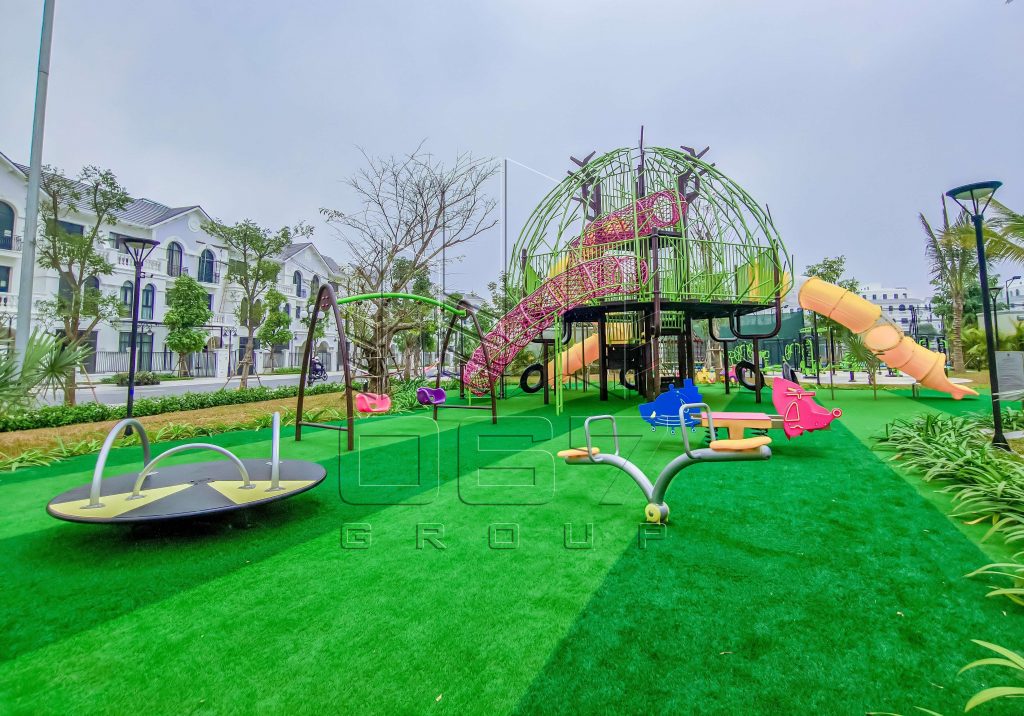
Yes, and hybrid layouts are common. Rubber takes the impact zones under equipment, grass takes the circulation and landscape zones between them, and a restrained edge detail keeps the junction from becoming a trip point. The split should follow the falling height map, not the budget, and the transition detail should be specified as carefully as the two surfaces themselves.
Getting Advice for Your Site
067 Group supplies and installs both rubber and EPDM safety surfacing and artificial grass systems, through its own brands including 3S GRASS, so the two options come from the same supply chain and the same quality system. If your site mixes equipment with landscape, we can specify the split: rubber where falls happen, artificial grass for play areas where appearance and drainage drive the decision, and a transition detail that holds up.
To discuss a specific site, contact our Hanoi office at No 38 Ven Ho Ha Dinh street, Ha Dinh ward, Thanh Xuan district, Hanoi, on +84 24 66 73 3777. Send the site plan and the equipment list you are considering, and we will propose a surfacing split by falling height zone with the quantities you need to compare quotes on equal terms. Completed installations are on our projects page.