
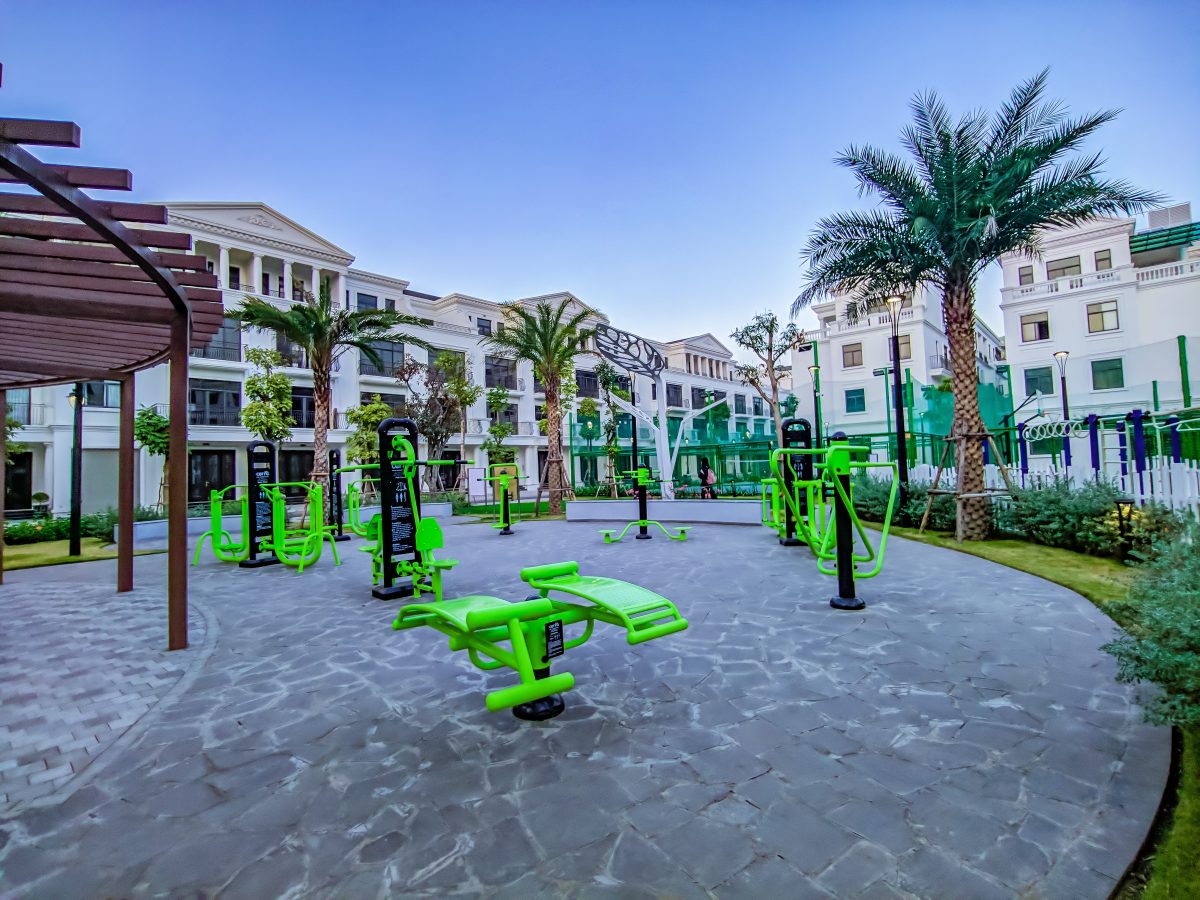
 Share
Play Equipment for Public Parks and Municipalities
Why Public Parks Need a Different Standard of Play Equipment
Public parks face a problem private playgrounds rarely do: the equipment must serve hundreds of children every day, in all weather, with no one on site. Choosing play equipment for public parks means planning for heavy use, mixed age groups and public liability. This guide covers the standards, maintenance and procurement decisions that keep a municipal installation safe.
A private playground inside a managed apartment complex serves a known population and a management team that can close the area when something fails. A municipal park serves the whole neighbourhood: toddlers supervised from a distance, school-age children after school, teenagers who use the structures harder than the design case assumes, and visitors who have never seen the site before. Nobody is on duty to stop a child from climbing the wrong way or to notice a loose bolt until a complaint arrives.
Public liability changes the calculation. When a child is injured in a public park, the question is not only what happened, but whether the authority can show that it selected, installed and maintained the equipment properly. The specification stage therefore carries more weight in a public project: the choices written into the tender document determine the maintenance cost and the risk profile for the whole service life.
Selecting Play Equipment for Public Parks: What Actually Matters
Several properties separate equipment that survives public use from equipment that only looks right in a catalogue. The first is structural robustness. Public structures should be specified with heavier wall thicknesses on load-bearing members, full penetration welding on critical joints, and stainless steel fasteners in exposed positions. Coatings matter as much as the steel: a powder-coated system rated for outdoor exposure outlasts a painted one by years in a tropical climate.
The second property is age zoning. A public park must serve children from about two years old to teenagers in the same space. The safe answer is not one big structure for everyone, but clearly separated zones: a toddler area with low fall heights and soft surfacing, a primary zone for five to twelve year olds, and a secondary zone with harder challenges for older children. Each zone needs its own fall-height logic, because the surfacing under a two year old cannot be the same as the surfacing under a twelve year old.
The third property is supervisory sightlines. In a public park there is rarely a paid supervisor, so the design must let parents see their children from the benches and paths. Through-play structures, open frames and limited visual barriers do more for public safety than any single component choice.
- Specify structural steel wall thickness and fastener grade in the tender, not just the equipment model number.
- Require separate age zones with distinct critical fall heights, each matched to its own surfacing.
- Choose open, see-through structures so parents can supervise from seating and paths.
- Require stainless hardware in all exposed and splash-zone positions.
- Insist on a full parts list with lead times before signing the contract.
Safety Standards and the Compliance File to Require
The right play equipment for public parks is defined less by appearance than by the standards it is designed against and the documentation that proves it. In Vietnam, the reference point is the TCVN 12730 series, with TCVN 12730-1:2019 covering playground equipment and its installation. The series is aligned with EN 1176, so a supplier working to the European standard works to the same engineering logic, but the tender should name the local standard explicitly.
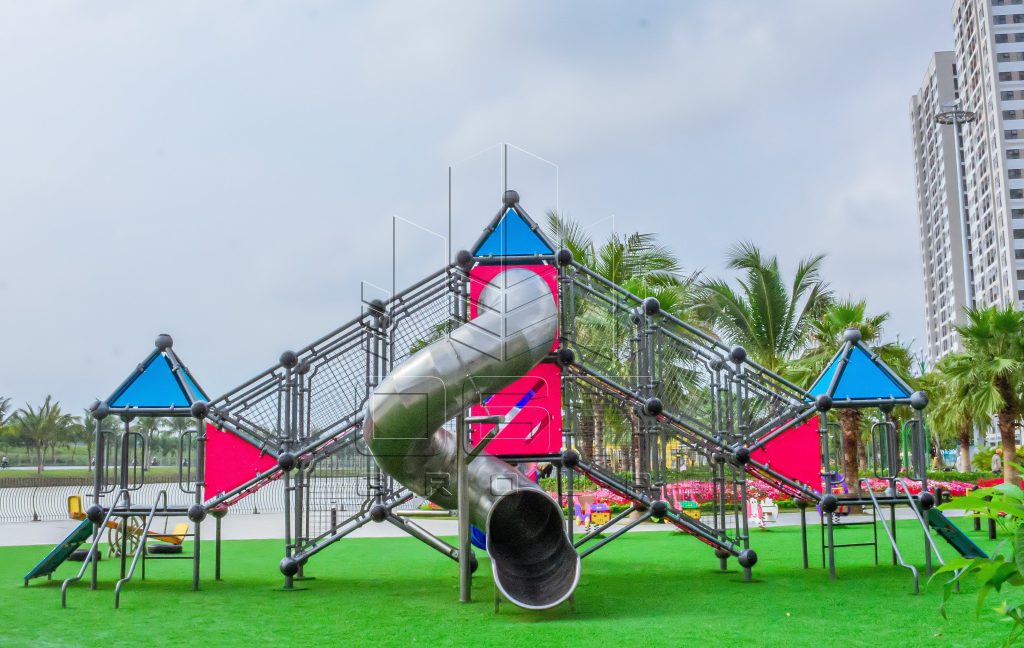
The standards a municipal file should reference are limited and well known:
- EN 1176, parts 1 to 11: design and manufacture of playground equipment and surfacing, plus the test methods.
- EN 1177: impact attenuating surfacing and the determination of critical fall height, the number that links a structure to the ground under it. EPDM safety surfacing typically runs 20 to 60 mm depending on the critical fall height it must absorb.
- TCVN 12730-1:2019: the Vietnamese national standard for playground equipment, the document a local authority will cite at acceptance.
- ASTM F1487 and ASTM F1292: the American equivalents for equipment and surfacing, relevant where a project references US practice.
- CPSC Public Playground Safety Handbook: the US public safety handbook, useful as a checklist of failure modes even where it is not the governing standard.
Standards alone do not protect a public client; what protects it is the compliance file: a declaration of conformity for each equipment line, test reports where the supplier can show them, a surfacing certificate stating the measured critical fall height, foundation and anchoring drawings, and a maintenance manual in the language of the operating team. A supplier who cannot produce this file before installation is a supplier who will produce it after the first complaint.
Durability and Maintenance Under Heavy Public Use
Public use is a maintenance problem before it is a design problem. The failure modes are predictable: fasteners loosen, coatings chip, welds fatigue at connection points, and surfacing degrades under sun and foot traffic. The difference between a park that costs almost nothing to run and one that is always under repair is whether maintenance is scheduled and recorded, or performed only after a failure.
The practical minimum is a tiered inspection regime: a short visual walk is cheap and catches most early failures, while a full mechanical inspection catches what the walk cannot see.
| Frequency | Scope | Who |
|---|---|---|
| Daily or weekly visual walk | Obvious damage, debris, loose parts visible from a distance, surfacing condition | Park operating staff |
| Monthly | Fastener torque check on accessible points, coating inspection, drainage under structures | Park staff or contracted technician |
| Quarterly | Full mechanical inspection against the manufacturer checklist, weld and anchor review, fall-height verification of the surfacing | Supplier or qualified contractor |
| Annual | Structural review, coating refresh plan, surfacing thickness and impact performance verification, update of the project record | Supplier engineer |
Under warranty, a scheduled maintenance cycle every three months is the norm for an established supplier, and each visit should end with a written record in the project file. When the record exists, acceptance and warranty claims are facts; when it does not, they are arguments.
Phased Installation and Budget Cycles
Municipal budgets are annual; park projects are not. The projects that get done are the ones shaped to the budget cycle, and phasing is how most municipalities make play equipment for public parks affordable: the core play area is installed in one cycle, the outdoor fitness zone follows in the next, and the landscaping and seating complete the site in a third.
Phasing has rules. First, the phase structure should follow the relative weight of the costs, not the convenience of the calendar. In a typical public playground package, design and survey are a small share, foundations and safety surfacing carry a large share, equipment supply and installation is the largest single item, and landscaping and accessories are moderate. Maintenance is a recurring cost that should be budgeted from year one, not discovered in year three.
Second, do not split the surfacing from the equipment it protects. Installing structures before the final surfacing is in place invites temporary ground, temporary protection and a second mobilisation. Third, keep each phase independently usable: a park that is half-finished and half-fenced is a public complaint for a full year. The tender documents should name the phases, the relative weight of each, and the interface between them, so that a change of contractor between phases does not reset the design.
Outdoor Fitness, Inclusive Access and the Whole Park
Modern municipal parks increasingly combine children’s play with outdoor fitness for adults. Permanently installed outdoor fitness equipment is covered by EN 16630, which specifies the structural and safety requirements for equipment that adults load with their own body weight. A fitness zone next to a playground is not a compromise: it extends the park’s hours of use, serves the older residents the playground ignores, and justifies the maintenance budget to a wider audience. The layout and separation logic is covered in our outdoor fitness equipment for parks guide.
Inclusive access is the other half of the same argument. A public park serves children with limited mobility, balance problems and sensory differences as well as typical children. The measures are unglamorous and cheap at the design stage: accessible routes with firm, stable surfaces, seating at the intervals parents actually need, equipment with transfer positions, and clear sightlines from the paths. Inclusive design is not a separate zone; it is the quality of the whole site.
The Supplier Process That Protects a Public Client
For a public client, the supplier’s process is part of the risk control, not a formality. A process that protects the authority runs in a fixed order: discuss the requirement and the budget, survey and measure the site, produce the design concept, sign the contract, install, and then maintain on a schedule. Each step produces a document that the next step and the acceptance committee can check.
067 Group operates this process on playground and park projects in Vietnam and France. The company holds ISO 9001:2015, ISO 14001:2015 and ISO 45001:2018 management system certificates, and its project records are kept in a company database that serves warranty and maintenance after handover. The full sequence is described on the our process page, and the quality control that happens during installation is the subject of our installation quality control article. For the supplier selection side of the decision, see choosing a playground equipment supplier in Vietnam.
If you are planning a public park project, the practical first step is a site survey and a budget discussion before any design work. 067 Group’s Hanoi office is at No 38 Ven Ho Ha Dinh street, Ha Dinh ward, Thanh Xuan district, Hanoi, and the team can be reached at +84 24 66 73 3777. Bring the site, the budget range and the timeline; the survey will tell you what the standard actually requires.
Frequently Asked Questions
Which standards should a public park playground comply with in Vietnam?
In Vietnam, the reference point is the TCVN 12730 series, with TCVN 12730-1:2019 covering play equipment for public parks and play areas. Most established suppliers also design to EN 1176 and EN 1177, which the national standard follows, and they should be able to show test reports and a declaration of conformity for every item in the package.
How often must public play equipment be inspected?
A short visual walk should happen daily or weekly, a fastener and coating check monthly, and a full mechanical inspection against the manufacturer checklist quarterly, with a structural review each year. Under warranty, a scheduled maintenance visit every three months is the norm for an established supplier, and every visit should end with a written record in the project file.
Can outdoor fitness equipment share the same area as a children’s playground?
Yes, with separation logic. Outdoor fitness equipment for adults falls under EN 16630, which assumes adult body weight and different fall scenarios, so the fitness zone needs its own surfacing logic and clear boundaries from the children’s zones. Shared paths, shared seating and shared maintenance schedules work well; shared fall-height logic does not.