
 Share
ShareQuality Playground Equipment in Hanoi: What to Look For
Why quality is hard to judge at the point of purchase
Two play structures can look identical in a rendering and behave very differently after three monsoon seasons. Buyers of playground equipment in Hanoi rarely have a way to inspect a weld, a coating thickness or a bearing before signing. This guide sets out the criteria that separate durable equipment from equipment that fails early, and how to test a supplier against them.
The advice below is written for developer project managers, landscape architects, school principals, apartment management boards and contractors bidding this package. It is deliberately supplier-neutral. Every criterion here can be verified by more than one competent manufacturer, and none of it requires you to take a sales claim on trust.
The equipment categories you will be specifying
Most residential, school and park schemes in northern Vietnam are built from a small set of recurring types. Knowing what each one demands helps you read a quotation properly.
Combined play units
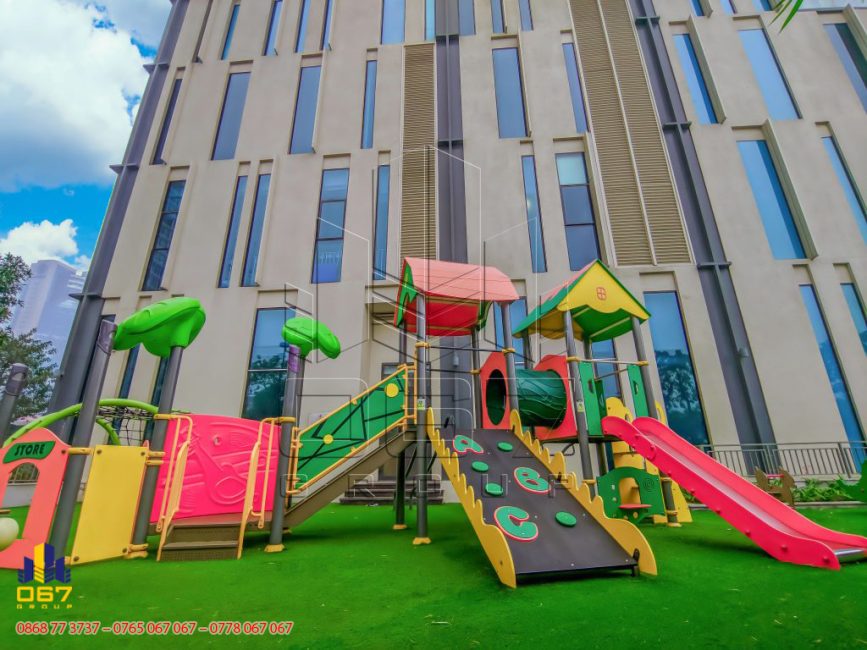
The anchor item on almost every site: decks, towers, slides, bridges and climbing access joined into one structure. They carry the highest load, occupy the biggest footprint and set the critical fall height for the whole area. Check deck heights, guardrail and barrier provision, and whether the slide sections are single-piece mouldings or bolted segments.
Climbing structures and rope play
Nets, boulders, arch climbers and rope pyramids. The failure points are terminations and swaged fittings rather than the rope itself. Ask for the rope construction, the core material and whether damaged sections can be replaced individually or only as a full net.
Roundabouts, spring riders and see-saws
Moving items concentrate wear in one place. Roundabouts live or die on the bearing assembly and on whether the gap between the rotating platform and the fixed ground can trap a foot. Spring riders depend on the spring steel and on how the spring is anchored into the foundation.
Trampolines and ground-level items
In-ground trampolines and ground-level equipment reduce fall height to almost nothing, which is why they suit dense residential courtyards. The cost then moves into groundworks and drainage rather than into the equipment itself.
What actually drives quality and price
Quotations for playground equipment in Hanoi vary widely for the same visual design. The variation is almost never arbitrary. It sits in a handful of line items.
| Element | What to ask for | Why it matters here |
|---|---|---|
| Steel treatment | Hot-dip galvanising or full pretreatment plus polyester powder coat; stated coating thickness | Humidity and salt-laden air attack untreated or thinly coated steel within a year or two |
| Panel material | Virgin HDPE with UV stabilisers, colour through the full thickness | Recycled or unstabilised panels chalk, fade and become brittle under direct sun |
| Fixings | Stainless or equivalently protected bolts, tamper-resistant heads, capped ends | Fixings are the first thing to corrode and the easiest thing to cheapen invisibly |
| Moving parts | Sealed bearings, bushes and chain grade, with replacement parts listed | Wear is expected; the question is whether it is serviceable |
| Surfacing | Impact attenuating surfacing tested to EN 1177 for the critical fall height of the tallest item | Surfacing is frequently under-specified to make a bid look cheaper |
| Certification | Test reports against EN 1176 or ASTM F1487, or the TCVN 12730 series | A certificate for one product line is not a certificate for the item you are buying |
| Installation | Foundation drawings, anchoring detail, named installation team | Correctly made equipment installed badly is still unsafe |
| Warranty and spares | Written warranty terms and confirmed lead time for spare parts | Determines whether a broken item is repaired in weeks or fenced off for a year |
Read the table as a weighting exercise rather than a price list. Structure and groundworks usually dominate the capital cost, surfacing is the second largest line and the one most often trimmed, and moving components carry a disproportionate share of the lifetime maintenance cost. If one bid is far below the others, the difference is normally in coating specification, panel grade or surfacing depth, not in profit margin.
Safety criteria that belong in the specification
Write these into the tender document rather than raising them at handover, when changes are expensive.
- Declared critical fall height for every item, with surfacing selected to match it and installed to the tested depth.
- Free space and falling space around each item kept clear of walls, kerbs, planting and drainage covers.
- No head or neck entrapment gap, no finger traps, no shearing points on moving equipment.
- Guardrails and barriers appropriate to deck height and to the age group the equipment is intended for.
- Rounded edges, capped bolt ends and no protrusions that can catch clothing or a drawstring.
- Foundations below the finished surface level, with no exposed concrete inside the impact area.
- Drainage designed for heavy rainfall so that surfacing does not sit in standing water.
- Handover documentation: layout drawings, equipment data sheets, test reports, installation records and an inspection regime.
Our companion article on playground equipment safety standards explains how EN 1176, EN 1177 and the TCVN 12730 series relate to each other, and what a genuine test report should contain.
How to evaluate a supplier of playground equipment in Hanoi
Product quality and supplier quality are separate assessments. A capable manufacturer with no local installation team will still leave you with a poor result.
Evidence, not brochures
Ask for test reports that name the product, not a generic company certificate. Ask which management systems are certified, for example ISO 9001, ISO 14001 or ISO 45001, and ask to see the scope on the certificate. Ask for completed projects you can visit, ideally ones commissioned three or more years ago, since new installations tell you nothing about durability.
Design and survey capability
A supplier that surveys the site before quoting will catch the things that wreck budgets later: levels, drainage, existing tree roots, service runs, access for delivery and lifting. A supplier that quotes from a plan alone transfers that risk to you. Our project process page sets out the sequence we follow, from requirement discussion and site survey through concept design, contract, installation and scheduled maintenance.
Installation and after-sales presence
Confirm that installation is carried out by the supplier’s own team or a named subcontractor, and that someone will attend site during commissioning. Confirm the response time for warranty calls and whether scheduled inspection visits are included. In Hanoi this matters more than it does in a temperate climate, because heat, ultraviolet exposure and prolonged humidity accelerate every failure mode.
Spare parts over the whole life
Swing seats, chains, bearings, spring elements and slide sections are consumables. Ask which parts the supplier stocks locally, which are imported to order, and what the typical lead time is. Guidance on planning that cycle is set out in our playground equipment maintenance checklist.
A practical shortlisting sequence
- Define the user age groups, the site area and the budget envelope before speaking to anyone.
- Issue the same brief to every bidder, including surfacing and groundworks, so the bids are comparable.
- Require a bill of quantities that separates equipment, surfacing, groundworks, installation and documentation.
- Request material and coating specifications in writing, and reject unnamed material grades.
- Visit at least one completed installation of similar age and exposure.
- Compare warranty terms, spare part lead times and the inspection schedule, not headline totals.
- Agree the handover pack and the post-installation inspection regime before signing.
Buyers procuring for a residential scheme will find further context in our guide to playground equipment for apartment buildings in Vietnam, which covers shared courtyards, noise and management board approvals.
Questions buyers ask
Is imported equipment always better than locally manufactured equipment?
No. Origin is a weaker predictor than specification. A locally made unit with hot-dip galvanised steel, virgin HDPE panels and stainless fixings will outlast an imported unit built to a lower grade. Origin does affect spare part lead time, so check availability of replacement components before deciding.
How long should playground equipment in Hanoi last?
Well-specified steel and HDPE equipment that is inspected and maintained on schedule should give many years of service, with moving parts and swing seats replaced periodically. Poorly coated steel and unstabilised plastics can deteriorate visibly within two or three years in this climate, which is why coating and panel grade deserve close attention.
Can surfacing be added later to reduce the initial budget?
It should not be. Surfacing is a safety component, not a finish. The impact attenuating surfacing must match the critical fall height of the tallest item from the day the equipment opens. Deferring it usually costs more, since the area has to be closed and prepared a second time.
What documents should be handed over at completion?
Layout and foundation drawings, data sheets and test reports for each item, the installation record, the warranty schedule, a maintenance and inspection plan, and a spare parts list with part references. Without these, routine inspection becomes guesswork and warranty claims are difficult to support.
Talk to 067 Group
067 Group consults on, designs, supplies and installs children’s play equipment, outdoor fitness equipment and safety surfacing, and works under the slogan “A better way to play”. Completed schemes are listed on our projects page if you would like to see delivered work before making contact.
To discuss a site, request a survey or ask for specification support, contact the Hanoi office at No. 38 Ven Ho Ha Dinh, Ha Dinh ward, Thanh Xuan district, Hanoi, or call +84 24 66 73 3777. We are happy to review a draft specification even at an early stage, when changes are still inexpensive to make.