
 Share
SharePlayground Investment and Cost Planning Guide
Why Playground Budgets Fail Before the First Quotation Arrives
Most playground budgets are set before anyone has measured the site. The number covers equipment, and little else. This guide sets out how a playground investment cost is actually structured, which lines are routinely omitted, and how to compare bids that look cheap because they are incomplete.
Nothing here quotes a figure. Prices move with specification, area, fall height, ground conditions and programme, so a published number would mislead more than it helps. What does not move is the shape of the budget: the same categories appear on every scheme, and the same three or four of them are the ones left out. Knowing the shape lets you challenge a quotation intelligently instead of simply choosing the lowest total.
What a Playground Investment Cost Really Contains
A playground is a small piece of civil engineering with play equipment fixed to it. The visible catalogue items are only one part of the total, and often not the part that decides whether the scheme lasts.
The lines buyers forget
- Site survey and setting out: measured levels, ground conditions, buried services and drainage behaviour, recorded before design rather than discovered during installation.
- Excavation, sub base and drainage: the layer nobody sees and nobody photographs, yet the single largest cause of premature surfacing failure when it is skimped.
- Edge detail: kerbs, upstands, transitions to grass or paving, and thresholds that must stay flush and trip free as the surface settles.
- Surfacing depth driven by critical fall height: depth follows the free fall height above it, tested to EN 1177 or ASTM F1292. It is a technical output, not a commercial choice.
- Shade: in a tropical climate this determines whether the space is usable in the middle of the day. Shade sails or structures are a real line, not a decoration.
- Fencing, gates and signage: including the operator information sign giving age guidance and an emergency contact.
- Installation supervision: someone competent confirming foundations, free space and fixings against the drawing rather than against habit.
- Post installation inspection: an independent check that the built playground matches the compliant design, produced as a report you can file.
- Spares: swing seats, chains, bearings, caps and fixings held from the start, because the cheapest part becomes expensive when it closes an item for weeks.
- Scheduled maintenance: routine, operational and annual inspection as described in EN 1176-7, plus the repairs those inspections generate.
Why surfacing and groundworks rival the equipment package
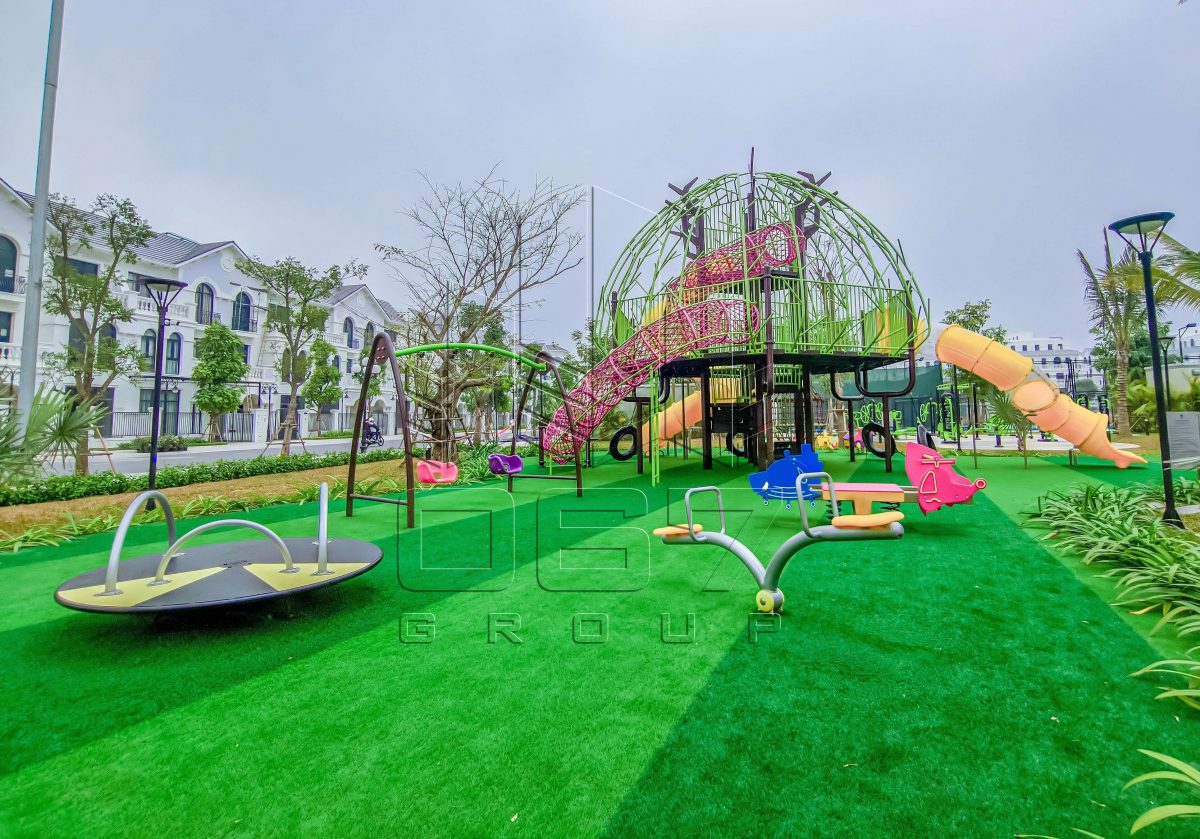
Impact attenuating surfacing is priced by area and by depth. Area follows the impact zones around each item, so a tall tower with a wide swing bay commits you to a large area whatever the frame costs. Depth follows the fall height above it, typically increasing from a thin build up under low toddler units to a substantially thicker system under high climbing structures. Multiply a larger area by a greater depth and add the sub base beneath it, and the groundworks and surfacing package regularly represents a significant share of the total, sometimes approaching or exceeding the equipment itself. A budget that treats surfacing as a finishing item has already failed.
Whole Life Cost Against Capital Cost
Capital cost is what you pay to open the space. Whole life cost is what you pay to keep it open and safe for its intended service life. The two rank suppliers differently, and only one of them matters to the person who owns the asset in year five.
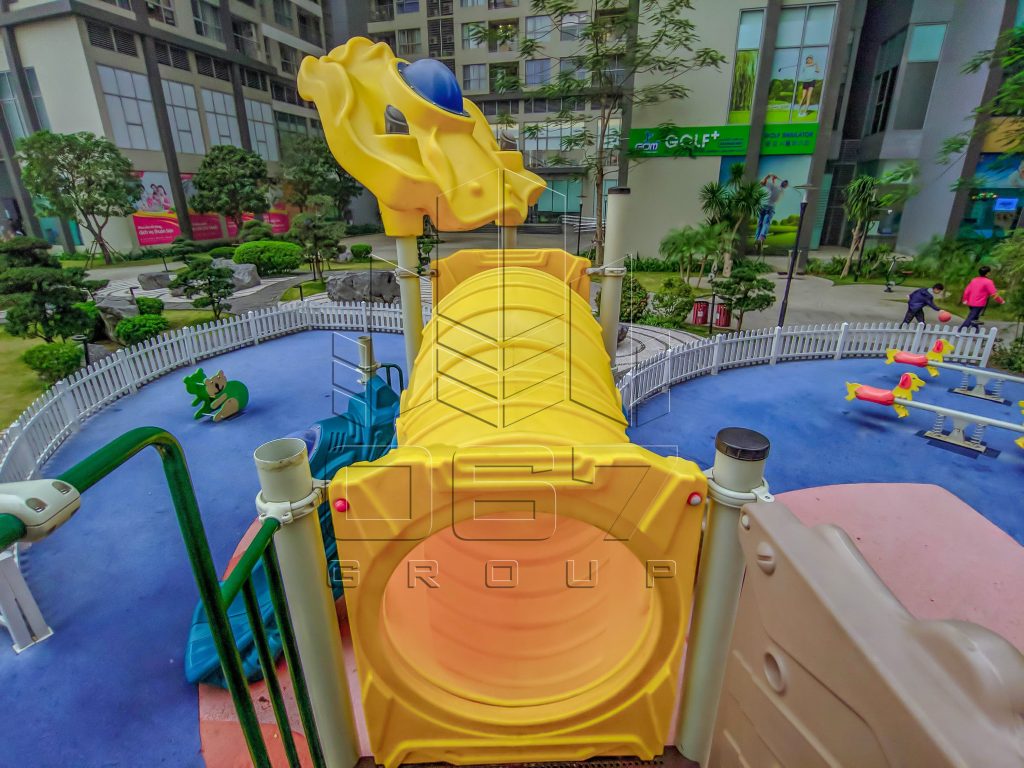
Whole life thinking changes specific decisions. Hot dip galvanised and powder coated steel, marine grade stainless fixings, and UV stable polymers cost more at purchase and less over time in a humid coastal climate. A surfacing system chosen for repairability lets you patch a worn landing zone instead of relaying a whole bay. Equipment from a supplier who keeps project records means a replacement part can still be matched years later, rather than forcing the removal of a whole unit because one component is obsolete.
Write the intended service life into the brief. If the client expects ten years of heavy residential use, say so, and require the bidders to price maintenance and consumable replacement against that horizon. Our guide to planning a playground project from brief to handover shows where in the programme each of these decisions has to be made.
A Playground Investment Cost Checklist You Can Use
Take this table into the budget meeting. Every line in a playground investment cost belongs to one of these categories, and the third column is where money leaks.
| Line item | What drives it | Common omission |
|---|---|---|
| Site survey | Site size, level change, unknown buried services | Assumed from a PDF plan, never measured on site |
| Excavation and spoil removal | Depth of build up, ground conditions, access for plant | Nobody is contracted to remove the spoil |
| Sub base and drainage | Surfacing type, permeability, existing water paths | Priced as a thin layer, then fails under load |
| Safety surfacing | Impact area and critical fall height per zone | One depth quoted for the whole area |
| Edge detail and transitions | Perimeter length, adjoining finishes, level differences | Left to the landscape contractor by assumption |
| Equipment | Age bands, play value mix, materials, origin | Ancillary items such as fencing panels or seating |
| Foundations and fixings | Manufacturer detail, soil bearing, item height | Concrete volume underestimated on sloping sites |
| Shade and comfort | Orientation, exposure, surface temperature | Deleted in value engineering, then added later at higher cost |
| Fencing, gates, signage | Traffic, water bodies, supervision model | The operator information sign |
| Installation and supervision | Programme, site access, working restrictions | Out of hours or phased working on a live site |
| Post installation inspection | Scheme size, standard applied | Not commissioned at all |
| Spares holding | Consumable components, expected use intensity | Ordered only after the first breakage |
| Scheduled maintenance | Use intensity, environment, inspection regime | Assumed to be free because it is under warranty |
| Contingency | Ground risk, design maturity, programme risk | Absent entirely |
Comparing Quotations That Are Not Like For Like
Two bids for the same playground can differ widely and both be honest. The gap is usually scope, not margin. Normalise before you compare.
Normalise the scope
Rewrite each bid onto a single common line structure using the table above, and mark every line the bidder has excluded. A quotation that excludes excavation, spoil removal and drainage is not cheaper, it is smaller. Ask each bidder to confirm in writing which lines they are not carrying so the difference is visible rather than inferred.
Normalise the surfacing
Require the surfacing to be quoted as a tested system build up with a stated critical fall height per zone and an area in square metres. Without that, one bidder is pricing a thinner build up than the design requires and will look better on paper until the first inspection. This is the largest single source of apparently unbeatable pricing.
Normalise warranty and inspection
Compare warranty by component category, not by headline duration, and check what the warranty actually obliges the supplier to do and how quickly. Then compare the inspection regime: how many scheduled visits during the warranty period, what each visit includes, and whether a written report is issued. A supplier returning on a scheduled basis every three months is carrying real cost that a cheaper bid has simply left out.
Supplier capability sits behind all three of these checks. The questions and documents worth asking for are set out in our guide to choosing a playground equipment supplier in Vietnam.
Phasing a Scheme, and the Cost of Getting It Wrong
Build the sub base once
When the budget will not cover the full scheme, phase the equipment and never the compliance. Design the whole layout first, then build the foundations, drainage and surfacing base for the entire area in phase one. Later phases then drop equipment onto ground that is already prepared. The alternative, breaking up finished surfacing to reach a new foundation, means paying twice for the same groundworks and leaving a visible patch line for the life of the space.
What a wrong specification actually costs
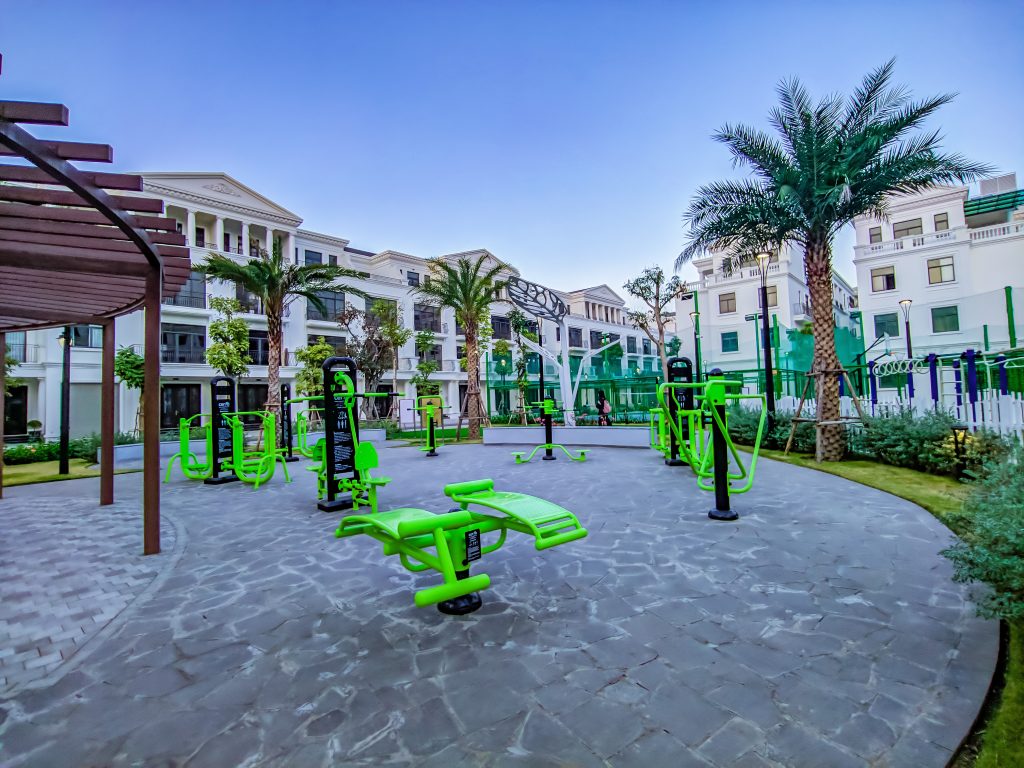
The consequences of an underfunded scheme are rarely a refund. They are early replacement of components that were never rated for the use they received, closure of an item or a whole area after an inspection finding, remedial groundworks once water has undermined the surfacing, and the reputational cost to a management board or school that has to tape off a new facility. Remedial work is always more expensive than the saving that caused it, because it carries demolition, disposal and rework on top of the original scope. Managing a playground investment cost properly means funding the invisible layers first, then buying the equipment the remaining budget genuinely supports. For shared residential courtyards the constraints are tighter again, as we describe in our guide to playground equipment for apartment buildings in Vietnam.
Frequently Asked Questions
Should I choose the lowest bid?
Only after you have proved the bids cover the same scope. Rewrite each onto a common line structure, confirm the surfacing build up and critical fall height, and check what maintenance and warranty obligations are included. If the lowest bid is still lowest once the exclusions are added back, it is genuinely the lowest.
Why is the surfacing quotation so different between suppliers?
Usually because the build up differs. Surfacing depth is set by the fall height above each item and verified by test, so a thinner system priced across the whole area will always undercut a correctly zoned specification. Ask for area in square metres, system type and stated critical fall height per zone before comparing totals.
What should be budgeted for maintenance?
Budget for three things: the scheduled inspection regime described in EN 1176-7, the consumable parts those inspections will condemn, and a reactive allowance for damage. Use intensity and environment drive all three, so a heavily used coastal residential courtyard needs a larger allowance than a supervised kindergarten yard of the same area.
How much contingency should a playground investment cost carry?
Enough to absorb ground risk and design development, sized against how much you actually know. A scheme with a completed survey, confirmed levels and a fixed component schedule needs less than one being priced from an outline plan. Carrying no contingency at all is the most common budgeting error on small schemes.
Working With 067 Group
067 Group provides consultancy, design, supply and installation of children’s playground equipment, outdoor fitness equipment, safety surfacing and park and landscape equipment, operating under ISO 9001:2015, ISO 14001:2015 and ISO 45001:2018 management systems. Our process begins by discussing the requirement and the budget, then assessing and measuring the location before any concept is drawn, so the groundworks and surfacing are priced from real site information rather than assumption. After installation we return for scheduled maintenance every three months during the warranty period, with project records kept on file for future warranty and maintenance work.
If you are building a budget for a new scheme or normalising quotations you have already received, you can reach us through the contact page or at the Hanoi office, No 38 Ven Ho Ha Dinh street, Ha Dinh ward, Thanh Xuan district, Hanoi, Vietnam, telephone +84 24 66 73 3777 or +84 24 66 73 9777.